⚖️Amidst Or Amid: Simple Explanation with Clear Examples
English learners and native speakers alike often pause when choosing between amidst and amid. They look similar, sound similar, and appear in similar contexts so why does English even have two versions of the same word? This small spelling choice creates big uncertainty, especially for writers who want to sound natural, professional, or region-appropriate.
People usually search for “amidst or amid” because they are unsure which word is correct, which one is more modern, or whether one is British English and the other American English. The confusion increases when both forms appear in news articles, academic writing, and everyday communication. Some style guides prefer one, while others accept both.
This article clears that confusion once and for all. You’ll get a quick answer for instant clarity, followed by a deeper explanation of meaning, origin, and usage. We’ll compare British and American English, show real-life examples, highlight common mistakes, and explain which form you should use depending on your audience. We’ll also look at Google Trends and usage patterns to see how people actually use these words today.
By the end, you’ll confidently know when to use amid and when amidst fits better without overthinking it.
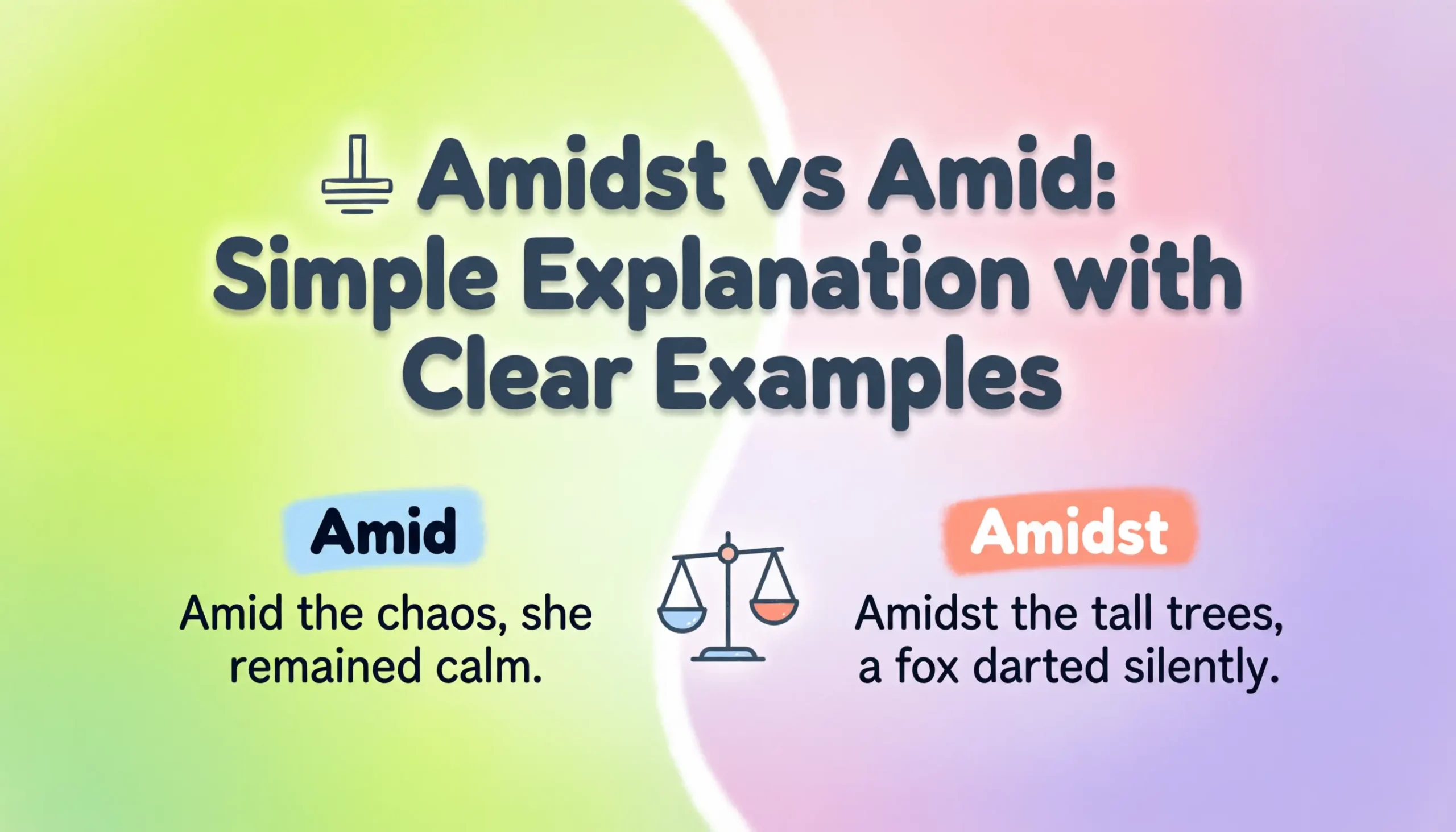
Amidst or Amid – Quick Answer
Both amid and amidst are correct.
They mean the same thing: “in the middle of” or “surrounded by.”
- Amid is more common and modern.
- Amidst sounds more formal or traditional.
Examples:
- She stayed calm amid the chaos.
- She stayed calm amidst the chaos.
Both sentences are correct. The difference is style, not meaning.
The Origin of Amidst or Amid
The word amid comes from Old English on middan, meaning “in the middle.” Over time, this shortened into amid.
The form amidst developed later. English once commonly added “-st” to words like:
- amidst
- amongst
- whilst
These endings became less common as English evolved. Modern English prefers shorter forms, which is why amid is now more widely used.
So, the spelling difference exists because English changed over time—not because the meaning changed.
British English vs American English Spelling
Both British and American English accept amid and amidst, but usage patterns differ.
- American English strongly prefers amid.
- British English uses both, but amidst appears more often in formal writing.
Comparison Table: British vs American Usage
| Aspect | Amid | Amidst |
| Meaning | In the middle of | In the middle of |
| American English | Very common | Rare |
| British English | Common | Fairly common |
| Tone | Neutral, modern | Formal, traditional |
| Length | Shorter | Longer |
Which Spelling Should You Use?
Your audience should guide your choice.
Use amid if:
- You are writing for a US audience
- You want a clear, modern tone
- You are writing blogs, emails, or general content
Use amidst if:
- You are writing for a UK or Commonwealth audience
- You want a formal or literary tone
- You are writing academic or poetic content
Global audience tip:
If you’re unsure, use amid. It is universally understood and widely accepted.
Common Mistakes with Amidst or Amid
Even though both forms are correct, people still make errors.
Mistake 1: Thinking one is wrong
❌ “Amidst is incorrect.”
✅ Both are correct.
Mistake 2: Mixing tone
❌ Casual email using “amidst”
✅ Use “amid” in informal writing.
Mistake 3: Overusing “amidst”
❌ The team met amidst lunch amidst noise.
✅ The team met amid lunch and noise.
Mistake 4: Confusing with “among”
❌ He stood amid people (awkward in casual tone).
✅ He stood among people.
Amidst or Amid in Everyday Examples
Emails
- We continued working amid delays.
- We continued working amidst unexpected delays.
News
- Markets fell amid economic concerns.
- Talks resumed amidst rising tensions.
Social Media
- Laughing amid all this stress 😂
- Finding joy amidst the madness.
Formal Writing
- The policy was revised amidst growing criticism.
- The policy was revised amid growing criticism.
Amidst or Amid /Google Trends & Usage Data
Search data shows that “amid” is far more popular globally, especially in:
- United States
- Canada
- Australia
“Amidst” shows stronger usage in:
- United Kingdom
- Academic and literary contexts
In news headlines and SEO content, amid dominates because it is shorter, clearer, and more searchable. Writers often choose it for readability and global reach.
Comparison Table: Amidst or Amid
| Feature | Amid | Amidst |
| Correct English | Yes | Yes |
| Meaning | In the middle of | In the middle of |
| Style | Modern | Traditional |
| Best for SEO | Yes | Less ideal |
| Preferred globally | Yes | No |
| Formal tone | Acceptable | Strong |
FAQs:
1. Are amid and amidst interchangeable?
Yes. They mean the same thing and can replace each other.
2. Is amidst more formal than amid?
Yes. Amidst sounds more traditional and formal.
3. Which one is better for American English?
Amid is strongly preferred.
4. Which one is better for British English?
Both are fine, but amidst appears more in formal writing.
5. Is amidst outdated?
No, but it is less common today.
6. Should I use amidst in SEO writing?
Amid is usually better for clarity and search intent.
7. Can I use amidst in academic writing?
Yes. It is often used in formal contexts.
8. Do style guides prefer one?
Many modern style guides prefer amid.
Conclusion:
The choice between amidst or amid is not about correctness it’s about style, audience, and tone. Both words share the same meaning: “in the middle of” or “surrounded by.” Historically, amidst grew from an older English structure, while amid reflects modern language preferences.
Today, amid is the safer and more versatile option. It works well in American English, global communication, Content writing, and everyday use. Amidst, on the other hand, still has value. It adds a formal or literary tone and fits well in British English or academic contexts.
If you want clarity, simplicity, and broad acceptance, choose amid. If your writing aims for tradition or formality, amidst can still shine. Understanding this difference helps you write with confidence, precision, and professionalism without second-guessing your word choice.
In short:
👉 Meaning is the same. Style is the difference. Choose wisely.

I am an experienced content writer specializing in modern English usage, vocabulary comparisons, and language learning guides. I write clear and concise explanations to help readers quickly understand the correct word choice. My writing style is practical, SEO-friendly, and ideal for students, bloggers, and non-native English learners



Post Comment