Analog or Analogue: Which Spelling Is Correct? Explained Simply
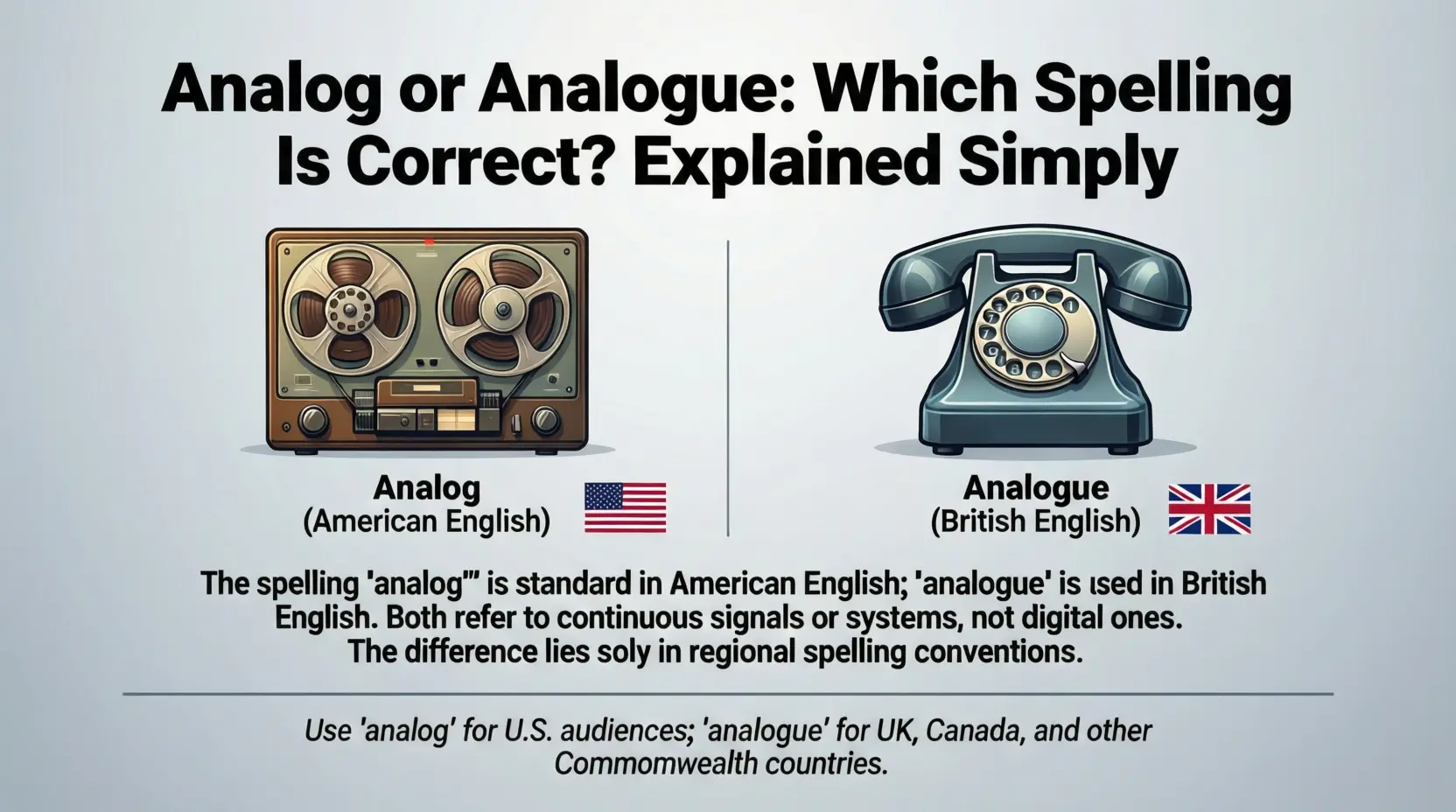
People often wonder whether the correct word is “analog” or “analogue.” This question pops up in writing, texting, editing, and even academic work. The confusion comes from English’s rich history and its global spread.
Some people learned English in the United States, while others learned British English. That difference affects spelling, meaning, and usage. Searchers want a quick answer: “Which form should I use?” They also want to know why two versions exist and when each one is best.
This article solves that confusion with clear examples, easy rules, and practical tips for writers everywhere. By the end, you’ll know how to use analog and analogue confidently in emails, essays, reports, and social posts.
You’ll see how spelling varies by region and why machines like analog clocks or digital watches get labeled differently. If you ever hesitate before typing the word, this article will give you the right choice every time.
Analog or Analogue – Quick Answer
Simple Rule:
- “Analog” → American English
- “Analogue” → British English & other English‑speaking regions
Examples:
- He prefers analog photography. (US)
- The UK store sold analogue watches. (UK)
- The teacher explained analog signals. (US textbook)
- The lab measured analogue voltage. (British science book)
Both spellings refer to the same idea: something continuous or not digital.
The Origin of Analog / Analogue
The word comes from the Greek “analogos,” meaning proportionate or corresponding to.
Over time, it entered English through Latin and Old French forms.
In early English, the spelling analogue was common. Writers used it broadly for ideas, machines, clocks, and even people who resemble others. In the 19th and 20th centuries, American printers and dictionaries simplified many British spellings. This included dropping the final ue in certain words. That change gave rise to analog in US usage.
So, the two spellings exist because of historical changes in English spelling standards — not because they mean different things.
British English vs American English Spelling
English spelling varies by region. Words like colour/color or centre/center follow similar patterns.
Comparison Table: Analog vs Analogue
| Feature | Analog (US) | Analogue (UK/Intl) |
| Primary Use | Standard | Standard |
| Region | USA | UK, Australia, India, Canada, South Africa |
| Print Media | Common | Common |
| Digital Context | Yes | Yes |
| Science & Tech | Used | Used |
Key Point:
The choice is based on reader location and style guide (e.g., AP Stylebook vs Oxford).
Which Spelling Should You Use?
Choosing between analog and analogue depends on your audience:
If you write for US readers
Use analog.
Examples:
- analog clock
- analog signal
- analog sensor
If you write for UK or Commonwealth audiences
Use analogue.
Examples:
- analogue watch
- analogue technology
- analogue recording
Global or online content
- Pick one and stay consistent.
- If you target the US market, choose analog.
- If your content targets a British or international audience, choose analogue.
Formal writing (academia or publications)
Check the style guide:
- APA, Chicago, or MLA → follow American or British standard as required.
- Scientific journals sometimes prefer analog because of technical norms.
Common Mistakes with Analog / Analogue
Many writers make mistakes that can affect clarity or SEO.
❌ Common Error 1: Switching forms mid‑text
Wrong: The device had an analog interface, though it was an analogue model.
✔️ Correct: Use one form consistently: The device had an analogue interface… (UK) or …an analog interface… (US)
❌ Common Error 2: Misplacing meaning
Some people think analog/analogue means old or outdated.
✔️ Correct: It means continuous, not old.
❌ Common Error 3: Wrong spelling in tech context
Some digital makers write analogue data when they mean digital.
✔️ Correct: Analog data refers to continuous real values — not numbers stored digitally.
Analog or Analogue in Everyday Examples
Here are real‑life ways the word appears in writing, speaking, and media.
Emails
- Please send the analog specs by Friday. (To US colleague)
- Our analogue samples are ready for review. (To UK client)
News Headlines
- Analog cameras still sell well among creatives.
- Analogue radio stations reach country listeners.
Social Media
- Choosing between analog and digital art tools!
- Love my new analogue planner — so calming!
In Formal Writing
- “The effect of analog signal noise was studied…”
- “This analogue device measures temperature continuously.”
Analog or Analogue – Comparison Table (Keyword Variations)
| Keyword Form | Usage Region | Context Example |
| analog | US English | Analog clock; analog technology |
| analogue | UK Intl English | Analogue watch; analogue signals |
| analogue vs analog | Comparative phrase | Teach differences and similarities |
Analog or Analogue – Google Trends & Usage Data
Search engines show how people query this topic worldwide:
- US audiences search more for “analog” spelling.
- UK, Australia, India, and Canada see more searches for “analogue.”
- Global search patterns reflect writing preferences and schooling standards.
People often search:
- Analog vs analogue
- Which spelling is correct?
- Analog definition
This indicates confusion about spelling and meaning. The trend is stable because English speakers everywhere encounter both forms.
FAQs:
1. Are analogand analoguethe same word?
Yes they mean the same thing. The difference is regional spelling.
2. Which one is correct in the US?
Analog is the standard American spelling.
3. Is analoguewrong in technical writing?
No analogue is correct in British and international contexts.
4. Should I use both in one article?
You can, but it’s better to pick one and stay consistent. Use variations only when intentionally explaining differences.
5. Why do both spellings exist?
Because British English typically keeps older spellings, while American English simplifies them.
6. In science, is there a meaning difference?
No. Both refer to continuous, non‑digital values.
7. Is analog always old technology?
No. It simply means continuous, not outdated.
8. What style guide should I follow?
Pick based on your audience and publication rules: AP/Chicago for US, Oxford/Cambridge for UK.
9. How do I spell it in code or UI text?
Follow your app’s language setting: analog for US, analogue for UK.
Conclusion:
When you are unsure whether to write analog or analogue, the answer depends on where your readers live and what style you follow. In the United States, analog is the preferred spelling. In the United Kingdom, Australia, India, and much of the Commonwealth, analogue is standard. Both words mean the same thing: something continuous and not digital.
For everyday writing consistency is a key. Choose one form and stick with it. If your audience is global, consider noting both versions early in your article to match search intent and help international readers find your content.
Understanding the difference helps you write confidently and accurately. Next time you type analog or analogue in an email, blog post, or report, you’ll know which spelling fits your readers best.

I am a professional English language writer and editor with a strong focus on word comparisons, spelling differences, and usage clarity. I specialize in explaining confusing English words in a simple, reader-friendly way. With a background in linguistics and digital content writing, I help learners understand British vs American English, commonly confused terms, and everyday grammar mistakes.




Post Comment