Arc or Arch – Which One Is Correct?
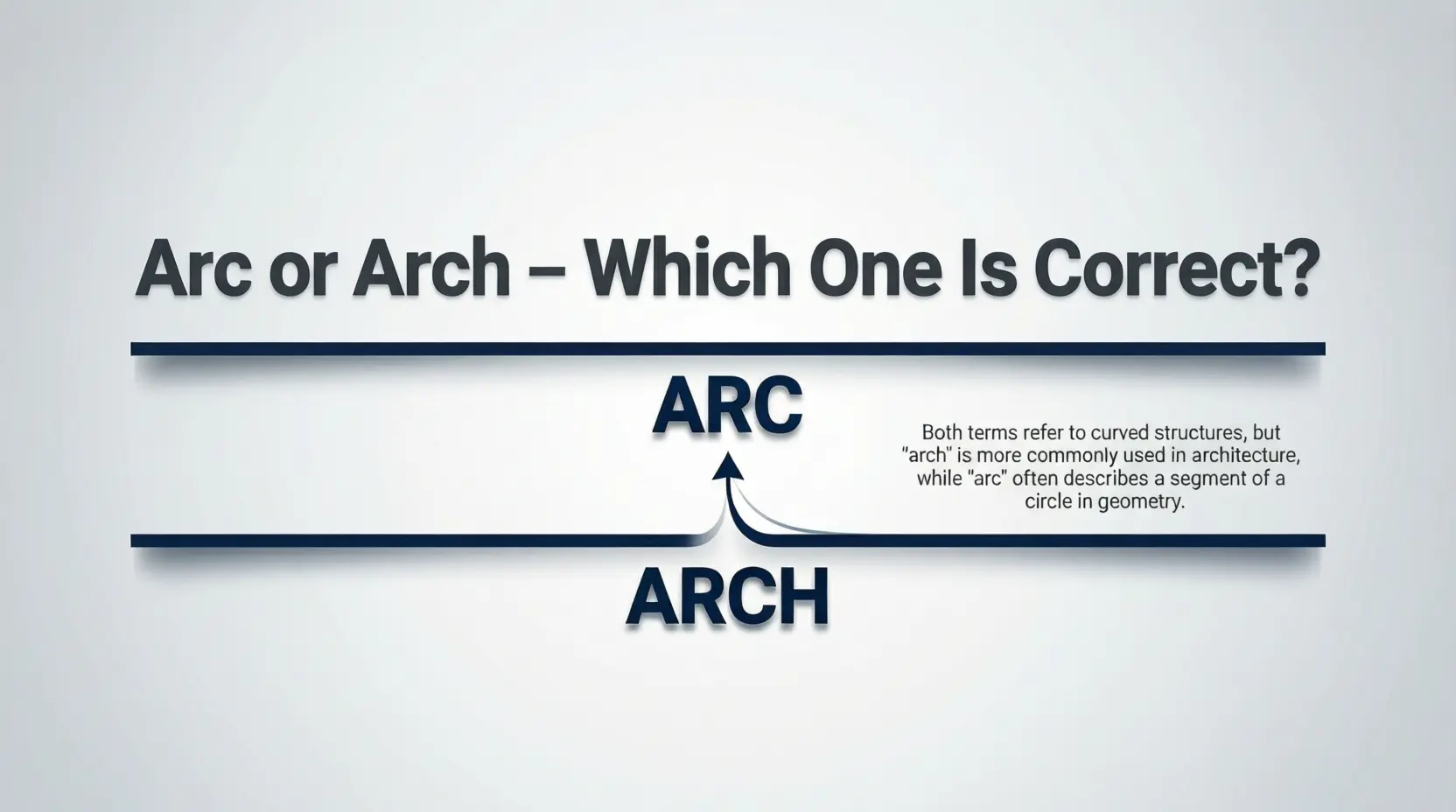
Many people search for “arc or arch” because these two words look similar, sound somewhat related, and are often confused in writing and speech.
You might see arc used in geometry, storytelling, or electricity, while arch appears in architecture, anatomy, and everyday descriptions. The confusion grows because both words can describe curves, shapes, or movements yet they are not interchangeable.
Writers, students, designers, engineers, and even casual email writers often pause to ask: Should I use arc or arch here?
A single wrong choice can change the meaning of a sentence or make it sound unprofessional. This confusion is common in academic writing, technical documents, and SEO content where accuracy matters.
This article solves that problem clearly and quickly. You’ll get a simple answer, real-world examples, history, spelling comparisons, common mistakes, and usage advice based on your audience.
By the end, you’ll know exactly when to use arc and when to use arch—with confidence.
Arc or Arch – Quick Answer
Arc and arch are different words with different meanings.
- Arc refers to a part of a curve, a path, or a gradual change.
- Arch refers to a structural curve, a physical shape, or something curved upward.
Examples
- The ball traveled in an arc through the air.
- The bridge has a stone arch.
- Her character shows a strong emotional arc.
- He raised an arched eyebrow.
Short rule:
👉 Use arc for paths, movement, math, or stories.
👉 Use arch for structures, shapes, or physical curves.
The Origin of Arc or Arch

Both words come from ancient languages, which explains why they look similar but mean different things.
Arc
- Origin: Latin arcus
- Meaning: bow, curve, or bend
- Entered English through mathematics and science
It became common in geometry (arc of a circle), physics (electric arc), and storytelling (story arc).
Arch
- Origin: Latin arcus, via Old French arche
- Meaning: a curved structure or framework
- Developed strongly in architecture and anatomy
Over time, English separated these meanings into two distinct words. The spelling difference exists to clarify function, not region.
British English vs American English Spelling
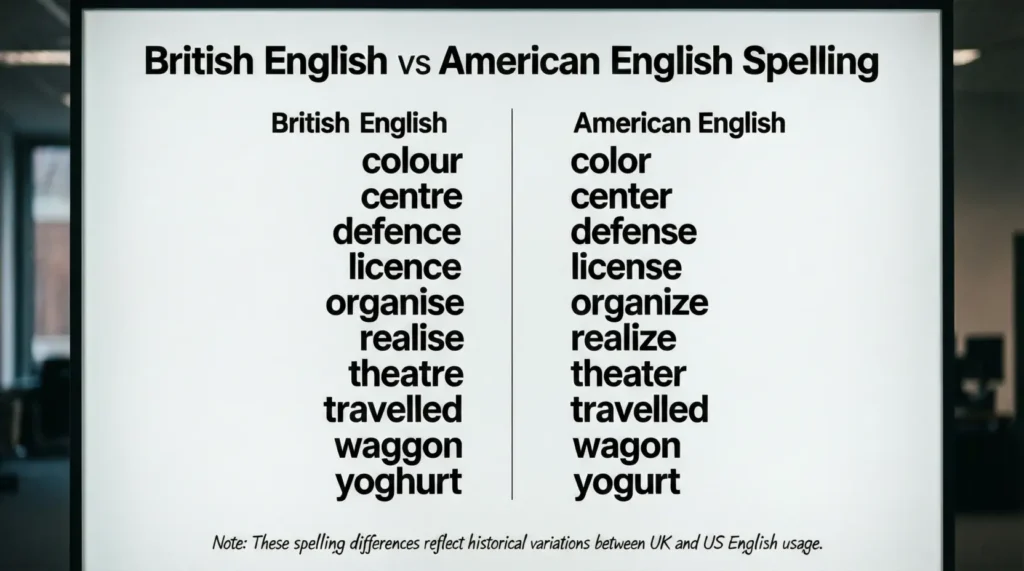
Unlike many spelling debates, arc vs arch is NOT a UK vs US issue.
Both British and American English use the same spellings and meanings.
Comparison Table
| Feature | Arc | Arch |
| US English | Arc | Arch |
| UK English | Arc | Arch |
| Type | Concept / Path | Physical Structure |
| Grammar | Noun | Noun / Verb / Adjective |
✅ No regional spelling change
❌ Not interchangeable
Which Spelling Should You Use?
Choose based on meaning, not location.
Use Arc if:
- You describe movement or direction
- You talk about geometry or science
- You explain personal or story development
Examples:
- Career arc
- Flight arc
- Narrative arc
Use Arch if:
- You describe a building or structure
- You refer to a physical curve
- You talk about posture or anatomy
Examples:
- Stone arch
- Foot arch
- Arched doorway
Professional tip:
In global or SEO writing, the wrong choice hurts clarity and trust.
Common Mistakes with Arc or Arch
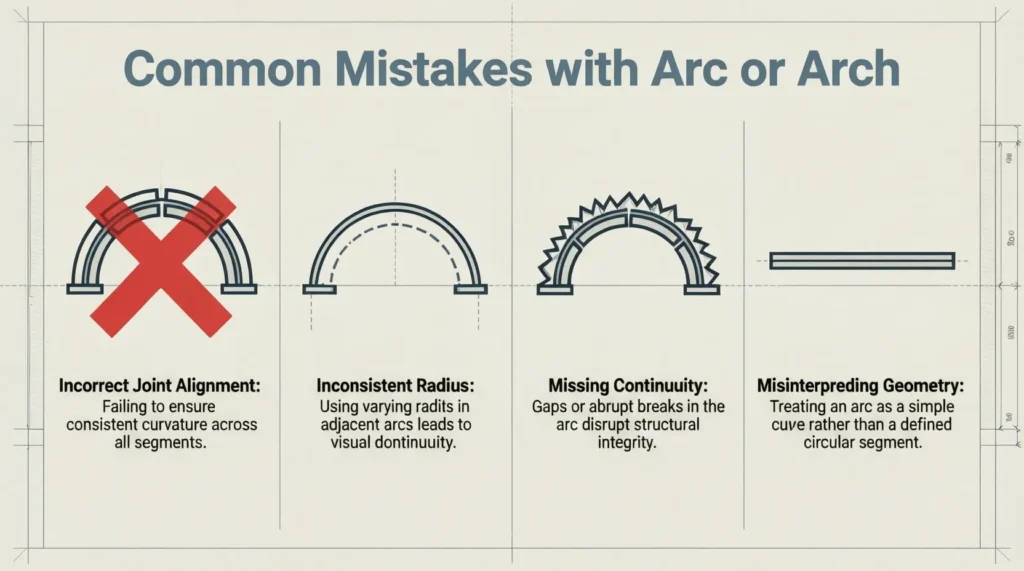
Here are frequent errors people make:
❌ Wrong
- The bridge has a beautiful arc.
- She has a high foot arc.
- The doorway arc is old.
✅ Correct
- The bridge has a beautiful arch.
- She has a high foot arch.
- The doorway arch is old.
Another mistake
- Using arch for emotional change
❌ His character arch is powerful.
✅ His character arc is powerful.
Arc or Arch in Everyday Examples
Emails
- “His career arc shows steady growth.”
- “The building features a stone arch.”
News
- “The missile followed a wide arc.”
- “The historic arch collapsed after the quake.”
Social Media
- “Love this character arc 😍”
- “That arched doorway is stunning!”
Formal Writing
- “The narrative arc defines the novel.”
- “Roman arches shaped ancient design.”
Arc or Arch / Google Trends & Usage Data
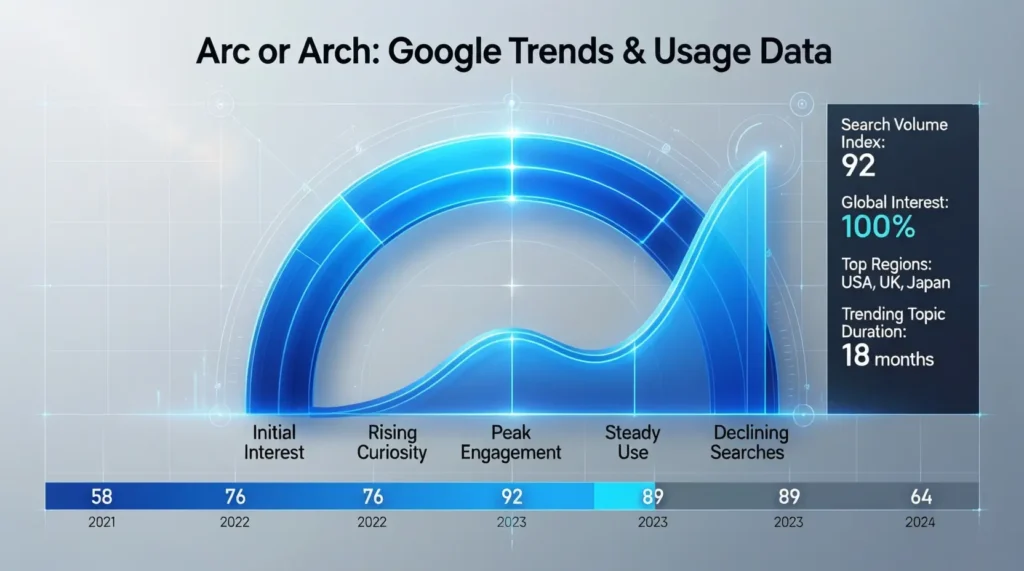
Search behavior shows clear intent differences:
- Arc is popular in:
- Storytelling
- Mathematics
- Physics
- Career advice
- Arch is popular in:
- Architecture
- Anatomy
- Construction
- Design
Usage by Context
| Context | Arc | Arch |
| Math | ✅ | ❌ |
| Buildings | ❌ | ✅ |
| Stories | ✅ | ❌ |
| Anatomy | ❌ | ✅ |
| Physics | ✅ | ❌ |
Arc or Arch – Comparison Table
| Aspect | Arc | Arch |
| Meaning | Path or curve | Curved structure |
| Usage | Abstract or motion | Physical or structural |
| Examples | Story arc | Stone arch |
| Part of speech | Noun | Noun / Verb / Adjective |
| Common confusion | Used for buildings | Used for stories |
FAQs:
1. Are arc and arch interchangeable?
No. They have different meanings and uses.
2. Is arc American and arch British?
No. Both spellings are used worldwide.
3. What is a story arc?
It is the emotional or narrative journey of a character or plot.
4. What is an arch in anatomy?
It refers to curved body parts, like the foot arch.
5. Can arch be a verb?
Yes. Example: He arched his back.
6. Is arc only used in math?
No. It’s also used in storytelling, careers, and motion.
7. Which word is more common?
Both are common, but in different contexts.
Conclusion
The confusion between arc or arch comes from their shared roots and similar meanings around curves. However, modern English clearly separates them. Arc describes movement, paths, progress, or abstract change. Arch refers to physical curves, structures, and shapes you can see or touch.
If you remember one rule, remember this:
👉 Arc moves. Arch supports.
Using the correct word improves clarity, professionalism, and reader trust especially in academic, technical, and SEO writing. Whether you are writing a novel, describing architecture, or sending a simple email, choosing the right term avoids confusion and shows precision.
Now, the next time you pause at arc or arch, you’ll know exactly which one belongs.

I am an English language specialist and educational writer focused on grammar rules, word differences, and clear communication. I have years of experience creating easy-to-understand guides that simplify complex English topics. Mine content is trusted by learners looking for accurate and well-structured language explanations.






Post Comment