Cacti Or Cactuses: Which Plural Is Correct and When to Use It?
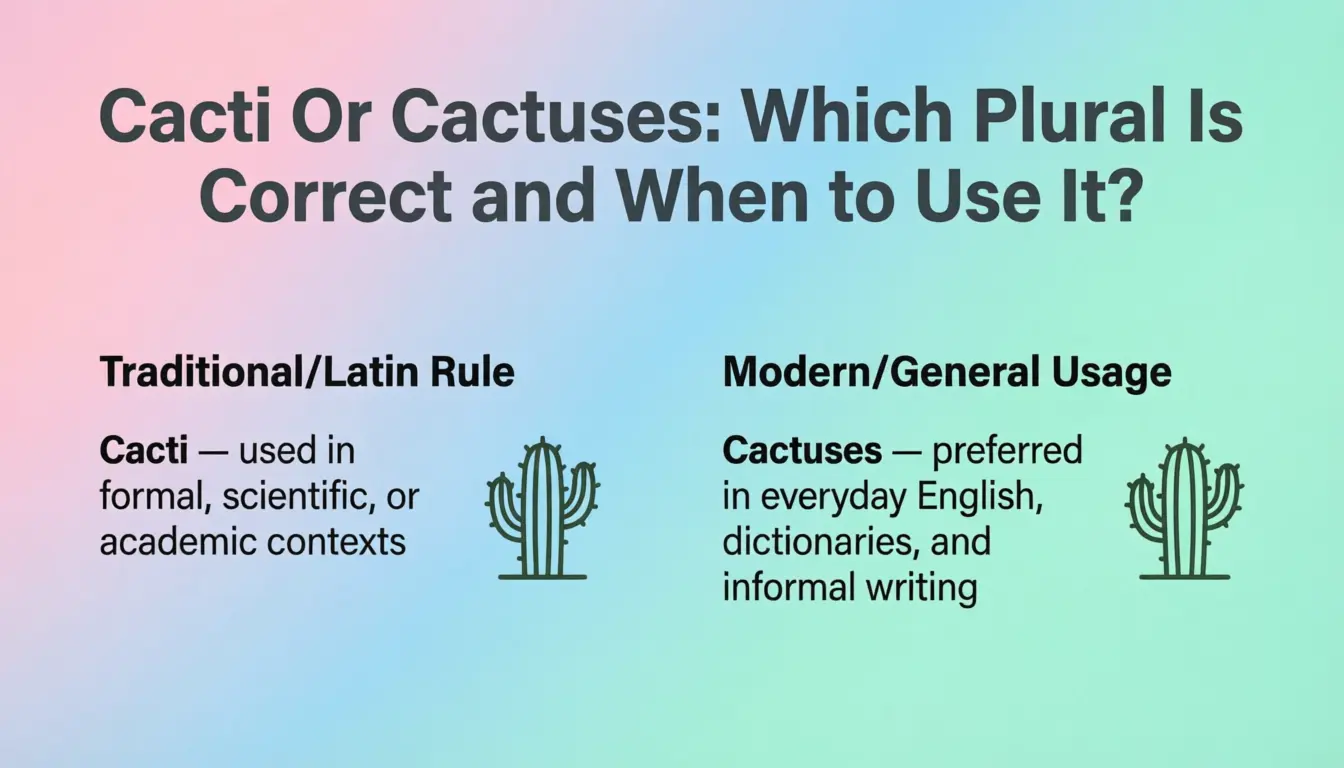
Is the plural of cactus cacti or cactuses? This simple-looking question causes a surprising amount of confusion for writers, students, gardeners, and even native English speakers. You might see cacti used in science books, while cactuses appears in everyday blogs and emails. So which one is actually correct?
People search for “cacti or cactuses” because English borrows words from other languages, and plural rules are not always clear. Some words keep their original foreign plural forms, while others adopt standard English endings. This creates uncertainty, especially when writing formally or for international audiences.
This article clears up that confusion once and for all. You’ll learn what cactus means, where both plural forms come from, and why both cacti and cactuses are grammatically correct. We’ll also explain how British and American English treat these forms, which one sounds more natural in different contexts, and how to choose the right option for your audience.
By the end, you’ll know exactly when to use cacti, when cactuses fit better, and how to avoid common mistakes if you’re writing an email, an academic paper, or a social media post.
Cacti or Cactuses – Quick Answer
Both cacti and cactuses are correct plural forms of cactus.
- Cacti is the traditional plural, borrowed from Latin.
Example: The desert is full of tall cacti. - Cactuses follows regular English plural rules by adding -es.
Example: These cactuses need very little water.
In short:
- Use cacti in scientific, academic, or formal writing.
- Use cactuses in casual, modern, or conversational English.
The Origin of Cacti or Cactuses
The word cactus comes from Latin, where it referred to a spiny plant. In Latin grammar, nouns ending in -us often form plurals ending in -i. That is how cactus became cacti.
When English adopted the word, it also adopted the Latin plural. For a long time, cacti was considered the “proper” plural, especially in botany and academic texts.
Over time, English speakers began treating cactus like a normal English noun. This led to the creation of cactuses, formed by adding -es, just like buses or boxes. Modern English dictionaries now accept both forms as correct.
The spelling difference exists because English is flexible. It allows both original foreign plurals and anglicised versions to coexist.
British English vs American English Spelling
Both British and American English accept cacti and cactuses, but usage trends differ slightly.
| Aspect | British English | American English |
| Scientific writing | Cacti | Cacti |
| Academic tone | Cacti | Cacti |
| Everyday speech | Cactuses (common) | Cactuses (very common) |
| Gardening blogs | Cactuses | Cactuses |
| Formal publications | Cacti | Cacti |
Key point:
There is no spelling difference, only usage preference based on formality and context.
Which Spelling Should You Use?
Your audience should guide your choice.
- US audience:
Use cactuses in casual writing; cacti in academic or scientific content. - UK & Commonwealth audience:
Both are acceptable, but cacti sounds more formal. - Global or ESL audience:
Cactuses is clearer and easier to understand. - Professional or academic writing:
Choose cacti to sound precise and traditional.
If unsure, cactuses is the safer choice for general readers.
Common Mistakes with Cacti or Cactuses
Here are frequent errors and how to fix them:
❌ These cactus are beautiful.
✅ These cacti are beautiful.
❌ Many cacti’s grow indoors.
✅ Many cacti grow indoors.
Cacti or Cactuses in Everyday Examples
Email:
We ordered three cactuses for the office desk.
News Article:
Rare cacti are protected by environmental laws.
Social Media:
Obsessed with tiny cactuses 🌵
Formal Writing:
Several species of cacti thrive in dry climates.
Cacti or Cactuses / Google Trends & Usage Data
Search data shows that “cacti” is more common in:
- Academic searches
- Science-related content
- Educational websites
“Cactuses” is more popular in:
- Gardening searches
- Home décor content
- Casual blogs and social media
By country:
- US: Higher use of cactuses
- UK: Balanced use
- Global: Cactuses preferred for clarity
Comparison Table: Cacti vs Cactuses
| Form | Origin | Tone | Best Use |
| Cacti | Latin plural | Formal | Science, academics |
| Cactuses | English plural | Casual | Everyday writing |
Practice Exercises
Exercise 1: Choose the correct word
- These desert ___ survive extreme heat.
- The shop sells small decorative ___.
Exercise 2: Rewrite formally
Many cactuses grow in Mexico.
Answers:
- cacti
- cactuses
Formal version: Many cacti grow in Mexico.
FAQs:
1. Are cacti and cactuses both correct?
Yes, both are grammatically correct.
2. Which is more formal?
Cacti is more formal.
3. Is cactuses American English only?
No, it’s accepted in British English too.
4. Do scientists prefer cacti?
Yes, scientific writing usually uses cacti.
5. Can I use cactuses in essays?
Yes, but cacti sounds more academic.
6. Is cactus’s ever correct?
Only as a possessive, not a plural.
7. Which should ESL learners use?
Cactuses is easier and clearer.
Conclusion:
The debate over cacti or cactuses is not about right versus wrong—it’s about context and audience. Both plural forms are fully accepted in modern English, and reputable dictionaries recognise them equally. The key difference lies in tone and usage.
Cacti comes from Latin and carries a formal, academic feel. It fits best in scientific writing, educational materials, and professional documents where traditional language is expected. On the other hand, cactuses follows normal English plural rules and feels more natural in everyday speech, casual writing, blogs, emails, and social media.
British and American English both allow either form, so you don’t need to worry about regional spelling errors. Instead, focus on consistency within your writing and clarity for your readers. When writing for a global or non-native audience, cactuses often works better because it is easier to understand.
In short, choose cacti for formality and precision, and cactuses for simplicity and friendliness. Once you know your audience, the decision becomes easy.

I am an experienced content writer specializing in modern English usage, vocabulary comparisons, and language learning guides. I write clear and concise explanations to help readers quickly understand the correct word choice. My writing style is practical, SEO-friendly, and ideal for students, bloggers, and non-native English learners




Post Comment