Carat Or Karat – Which One is Correct? For 2026
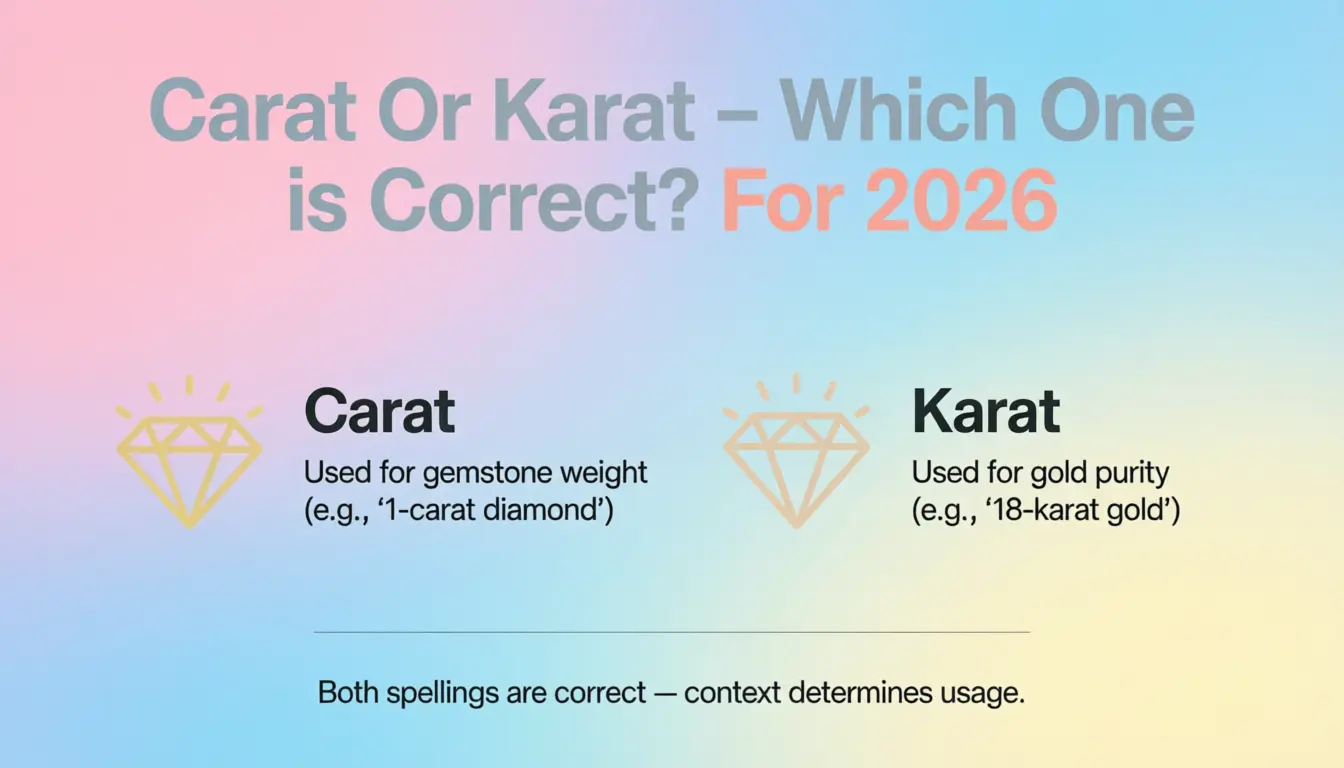
Have you ever wondered why some jewelry is labeled as “24 carat gold” while others read “24 karat gold”? The difference between carat and karat is a common source of confusion for shoppers, writers, and even professionals in the jewelry business. People often search this term to understand which spelling to use in writing, labeling, or describing precious metals and gemstones.
Knowing the correct usage is important because carat and karat are not interchangeable they refer to entirely different things. Using the wrong term can lead to misunderstandings, especially in professional or commercial settings.
In this article, we’ll give you a quick answer, explore the history, compare British and American spelling rules, show everyday examples, and offer guidance on which term to use depending on your audience.
By the end, you’ll have a clear understanding of carat vs karat, avoid common mistakes, and confidently use the right word in any context.
Carat or Karat – Quick Answer
- Carat (ct) – Refers to the weight of gemstones, especially diamonds.
Example: This diamond weighs 2 carats. - Karat (K or kt) – Refers to the purity of gold, measured out of 24.
Example: This necklace is made of 18-karat gold.
✅ Quick tip: Think “carat = gem weight, karat = gold purity.”
The Origin of Carat or Karat
The words carat and karat have distinct historical roots:
- Carat: Derived from the Greek word keration, meaning “carob seed,” which was historically used as a standard weight for gemstones. Carat became the international unit for measuring gemstone weight.
- Karat: Originates from the Arabic qirat, also meaning “small weight” (used for seeds and gold), but the spelling “karat” became common in the U.S. to refer specifically to gold purity.
Historically, both terms shared similar roots because seeds were used to measure tiny weights. Over time, the meanings diverged, and spelling differences emerged based on region and context.
British English vs American English Spelling
| Feature | British English | American English | Example |
| Gemstone weight | Carat (ct) | Carat (ct) | The diamond is 1.5 carats. |
| Gold purity | Carat (ct) | Karat (K or kt) | She bought 24-karat gold earrings. |
| Spelling rule | ‘C’ standard | ‘K’ common for gold | – |
Summary: In the UK, “carat” can refer to both gemstones and gold purity, though jewelers often still use “karat” for clarity. In the US, “karat” is standard for gold, while “carat” is reserved for gemstones.
Which Spelling Should You Use?
- US audience: Always use karat for gold and carat for gemstones.
- UK & Commonwealth countries: “Carat” is widely understood for both, but using karat for gold can prevent confusion in writing.
- Global writing: If you’re writing for international readers, use carat for gems and karat for gold for clarity.
Tip: For e-commerce, social media, or articles targeting jewelry buyers, this distinction improves credibility and reduces misinterpretation.
Common Mistakes with Carat or Karat
| Mistake | Correction | Explanation |
| Writing 24 carat gold in the US | 24-karat gold | “Karat” is correct for gold purity in US English. |
| Writing 2 karat diamond | 2 carat diamond | “Carat” measures gem weight, not purity. |
| Using carat interchangeably | Separate by context | Gem weight vs gold purity must be distinct. |
| Confusing abbreviations | ct = carat, K/kt = karat | Prevent mislabeling in invoices or jewelry tags. |
Remember: mixing the two can confuse customers, especially in sales or online listings.
Carat or Karat in Everyday Examples
- Emails: “The client requested 18-karat gold chains for the new collection.”
- News articles: “The auction featured a 5-carat diamond ring valued at $50,000.”
- Social media: “Check out this 24-karat gold pendant! #Luxury #Gold”
- Formal writing: “Each gemstone is carefully measured in carats to ensure accuracy.”
Using the correct term reinforces professionalism and ensures your audience clearly understands whether you’re talking about weight or purity.
Carat or Karat – Google Trends & Usage Data
Google Trends shows the following patterns:
- Carat spikes in searches around engagement rings, diamonds, and jewelry shopping globally.
- Karat is more common in U.S.-based searches related to gold jewelry, coins, and investment articles.
- Interest in carat is high in the UK, India, Canada, and Australia, reflecting Commonwealth spelling preferences.
- Businesses often optimize product pages using both keywords to capture global audiences.
Keyword Comparison Table
| Term | Meaning | Abbreviation | Region Preference |
| Carat | Gemstone weight | ct | Global (US & UK) |
| Karat | Gold purity | K / kt | US standard, also global for clarity |
FAQs:
1. Can I use carat for gold?
- In the US, no. Use karat for gold. In the UK, some use carat, but karat is clearer.
2. Is 24-carat gold the same as 24-karat gold?
- Yes, they both indicate pure gold, but karat is standard in US English.
3. How many carats is a diamond usually?
- Diamonds vary from 0.25 ct to over 5 ct in fine jewelry.
4. Is karat only used for gold?
- Yes, karat refers to gold purity only. Gemstones use carat.
5. How is carat measured?
- 1 carat = 0.2 grams. Gemstones are weighed using precise scales.
6. What’s the abbreviation for karat?
- K or kt. Examples: 14K, 18K, 24K.
7. Can I write “18ct gold”?
- Technically yes in UK English, but 18K or 18kt is preferred globally to indicate gold purity.
8. Why do people confuse carat and karat?
- Both words share the same linguistic roots and historically measured small weights, but their modern meanings differ.
9. Is there a difference between carat and caret?
- Yes. Caret (^) is a proofreading symbol, unrelated to carat or karat.
Conclusion:
Understanding the difference between carat and karat is crucial for clarity in writing, labeling, and professional communication. Carat always measures gemstone weight, while karat denotes gold purity. The distinction is particularly important in the US, where using the wrong term can mislead buyers.
In British English, “carat” is more flexible, but using “karat” for gold improves clarity, especially in international contexts. Always consider your audience: jewelry shoppers, readers, or global customers might interpret your words differently depending on the region.
Remember to use ct for diamonds and K/kt for gold in formal contexts. Applying this knowledge correctly will make your writing more professional, prevent costly mistakes, and improve for jewelry-related content. By following these guidelines, you’ll confidently navigate the carat vs karat dilemma.

I am an experienced content writer specializing in modern English usage, vocabulary comparisons, and language learning guides. I write clear and concise explanations to help readers quickly understand the correct word choice. My writing style is practical, SEO-friendly, and ideal for students, bloggers, and non-native English learners







Post Comment