Echoes Or Echos- Which Spelling Is Correct and When to Use It for 2026?
You may have seen both “echoes” and “echos” in writing and wondered: which one is correct? This small spelling difference confuses many English learners, writers, and even native speakers. It often appears in school assignments, emails, blog posts, and even published content.
Because spelling matters for clarity and professionalism, people search for “echoes or echos” to avoid mistakes.
The confusion comes from how English forms plurals. Some words simply add “-s,” while others take “-es.” Words ending in “-o” can be tricky, and “echo” is one of them. So, is it “echoes” or “echos”? And does it change in British or American English?
In this guide, you will get a clear answer, simple rules, real-life examples, and expert advice. By the end, you will know exactly which spelling to use and feel confident in your writing.
Echoes or Echos – Quick Answer
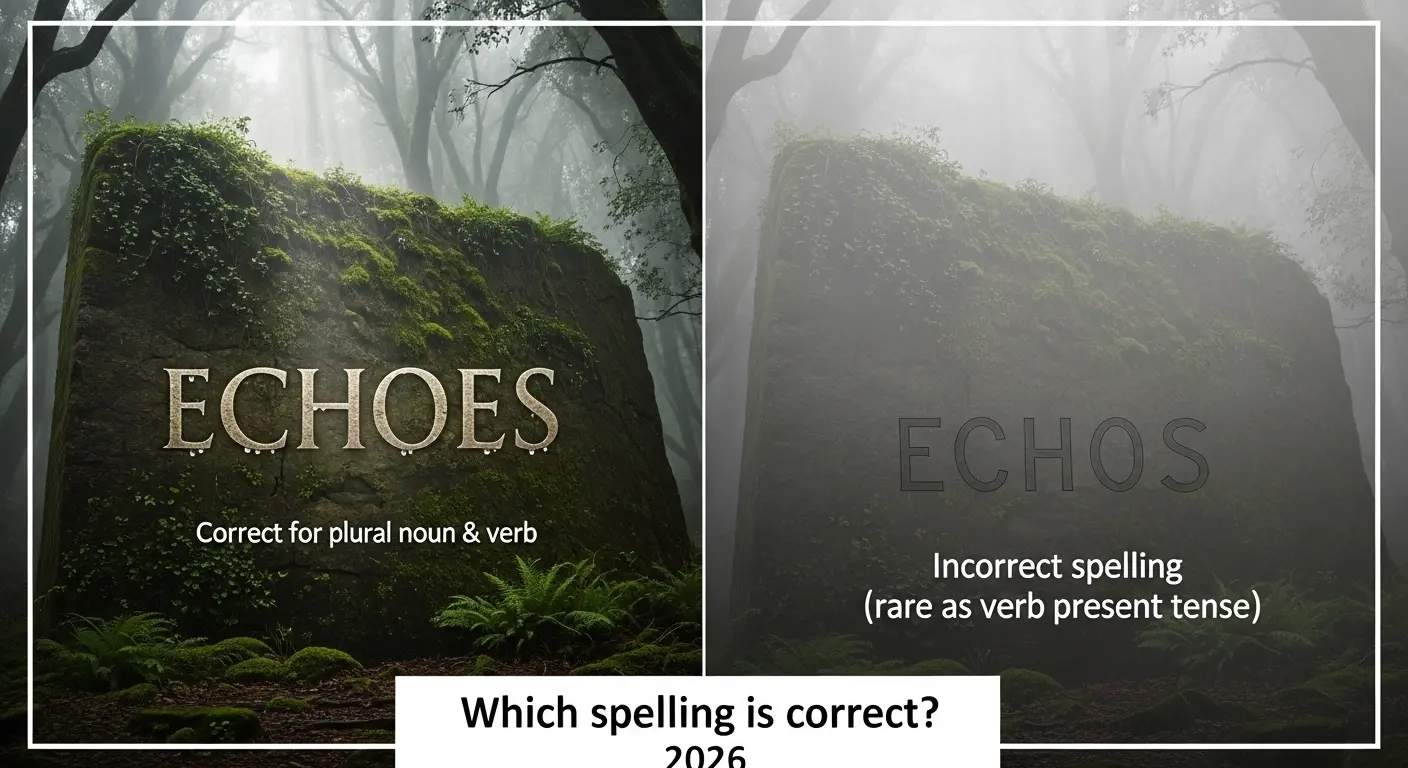
The correct plural form of “echo” is “echoes.”
“Echos” is generally considered incorrect in standard English.
Examples:
- Correct: The mountains returned our echoes.
- Incorrect: The mountains returned our echos.
- Correct: Her words created emotional echoes.
- Incorrect: Her words created emotional echos.
👉 Rule: Words ending in “-o” often take “-es” to form plurals, especially when the word comes from Greek or Latin.
The Origin of Echoes or Echos
The word “echo” comes from Greek mythology. It is linked to Echo, a nymph who could only repeat the words of others. Over time, the word entered Latin and then English, keeping its meaning related to sound reflection.
Because of its Greek origin, “echo” follows a traditional plural rule by adding “-es” to form “echoes.”
Historically, English has borrowed many words from Greek and Latin. These words often keep their original plural patterns. That is why we say:
- hero → heroes
- potato → potatoes
- echo → echoes
“Echos” appeared in some informal or incorrect usage, but it never became standard. Modern dictionaries and grammar guides clearly prefer “echoes.”
British English vs American English Spelling
Good news: there is no difference between British and American English for this word. Both use “echoes.”
Comparison Table
| Form | British English | American English | Correct? |
| Echoes | ✔ Yes | ✔ Yes | ✔ Correct |
| Echos | ✘ No | ✘ No | ✘ Incorrect |
Unlike words such as “color/colour” or “organize/organise,” “echoes” stays the same across regions.
Which Spelling Should You Use?
1. For US Audience
Always use “echoes.” It is the only accepted form in American English.
2. For UK & Commonwealth
Use “echoes.” British, Australian, and Canadian English all follow this spelling.
3. For Global or Online Writing
Stick with “echoes.” It is universally understood and correct.
👉 Simple advice:
If you want safe, correct, and professional writing, always choose “echoes.”
Common Mistakes with Echoes or Echos
Here are some frequent errors people make:
❌ Using “echos” as a plural
- Wrong: I heard strange echos at night.
- Right: I heard strange echoes at night.
❌ Confusing verb and noun forms
- Correct verb: The sound echoes in the valley.
- Correct noun: The echoes were loud.
Echoes or Echos in Everyday Examples
1. In Emails
- “Your feedback still echoes in my mind.”
2. In News Writing
- “The leader’s speech created strong echoes across the country.”
3. On Social Media
- “That moment still echoes in my heart ❤️”
4. In Formal Writing
- “Historical events often leave lasting echoes in society.”
5. In Casual Conversation
- “Our voices made cool echoes in the cave!”
Echoes or Echos – Google Trends & Usage Data
Search and usage data show a clear pattern:
- “Echoes” is widely used across the world.
- It appears in books, academic writing, and media.
- Countries like the US, UK, Canada, and Australia all prefer “echoes.”
“Echos” has very low usage and is often marked as a spelling mistake by tools like grammar checkers.
👉 Conclusion from trends:
“Echoes” dominates in both popularity and correctness.
Comparison Table: Echoes vs Echos
| Feature | Echoes | Echos |
| Spelling Type | Standard | Non-standard |
| Grammar Status | Correct | Incorrect |
| Usage Frequency | Very High | Very Low |
| Used in Media | Yes | No |
| Accepted Worldwide | Yes | No |
FAQs:
1. Is “echos” ever correct?
No. It is not accepted in standard English.
2. Why does “echo” become “echoes”?
Because words ending in “-o” often take “-es,” especially from Greek origin.
3. Do Americans use “echos”?
No. Americans also use “echoes.”
4. Can “echoes” be a verb?
Yes. Example: “The sound echoes loudly.”
5. Is “echoes” singular or plural?
It can be both:
- Verb (singular): The sound echoes.
- Noun (plural): The echoes were loud.
6. Are there similar words like this?
Yes:
- hero → heroes
- potato → potatoes
7. Why do people write “echos”?
Because they think all plurals just add “-s.”
8. Is “echo’s” correct?
Only for possession, not plural. Example: “The echo’s sound.”
Conclusion:
The confusion between “echoes” and “echos” is common, but the answer is simple. The correct spelling is “echoes.” It follows a standard English rule for words ending in “-o,” especially those with Greek roots. Both British and American English agree on this form, making it a safe and universal choice.
Using the correct spelling is important for clear communication. If you are writing an email, a blog post, or an academic paper, small mistakes like “echos” can affect your credibility. By remembering that “echo” becomes “echoes,” you avoid errors and improve your writing quality.
In everyday use, “echoes” appears in many contexts from sound reflections to emotional meanings. It is a flexible and powerful word. So next time you write, stay confident and choose “echoes” every time.

I am an experienced content writer specializing in modern English usage, vocabulary comparisons, and language learning guides. I write clear and concise explanations to help readers quickly understand the correct word choice. My writing style is practical, SEO-friendly, and ideal for students, bloggers, and non-native English learners





Post Comment