Encorporate or Incorporate: Which is Correct?
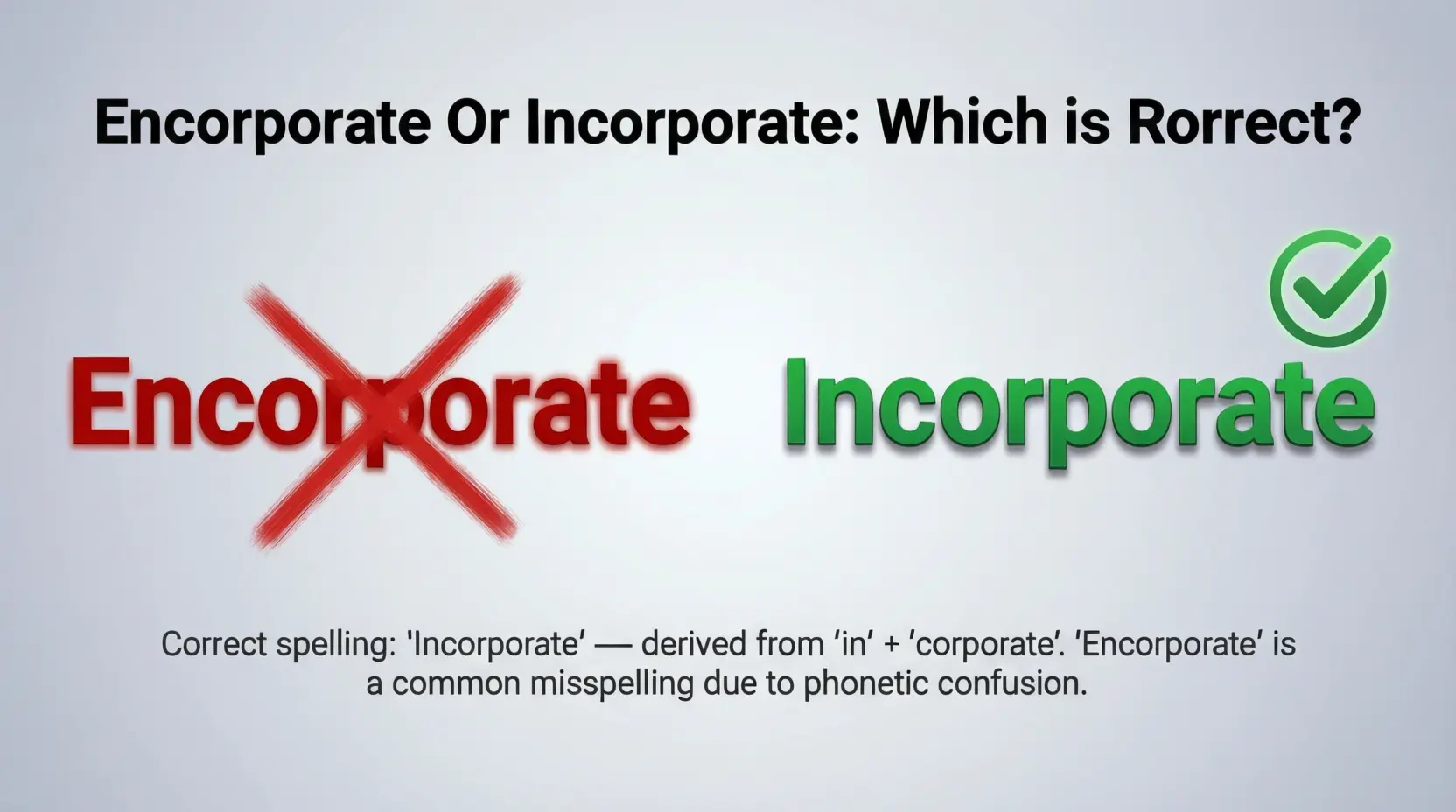
Many writers, students, and professionals often wonder whether to use “encorporate” or “incorporate.” The confusion arises because English spelling and pronunciation can be tricky, and small variations sometimes appear in informal writing or regional dialects.
People search for this keyword to clarify the correct usage in business, legal, academic, and everyday contexts. Using the wrong form can make communication appear unprofessional or unclear.
In this article, we will break down the correct spelling, explore its origins, compare British and American English usage, and provide practical examples.
By the end, you’ll confidently know when to use “incorporate” and avoid the common error of “encorporate.”
Encorporate or Incorporate – Quick Answer
The correct spelling is incorporate. “Encorporate” is a misspelling and not recognized in standard English dictionaries.
Example:
- Correct: We need to incorporate these ideas into our project.
- Incorrect: We need to encorporate these ideas into our project.
The Origin of Encorporate or Incorporate
The word “incorporate” comes from the Latin “incorporatus,” meaning “to make into a body or combine.” The prefix “in-” signifies “into” or “within,” while “corporate” relates to “body.” Over time, “incorporate” became the standard English form. The spelling “encorporate” likely emerged due to mishearing or regional variation but has no historical basis.
British English vs American English Spelling
Both British and American English use incorporate. There is no accepted variation such as “encorporate”.
| Feature | British English | American English |
| Correct Spelling | incorporate | incorporate |
| Common Mistake | encorporate | encorporate |
| Usage | Business, legal, academic | Business, legal, academic |
Which Spelling Should You Use?
Always use incorporate. If writing for a US audience, UK audience, or international readers, this spelling is universally recognized. Avoid “encorporate” entirely, as it may confuse readers or appear unprofessional.
Common Mistakes with Encorporate or Incorporate
- Using “encorporate” instead of “incorporate.”
- Confusing with similar-sounding words like “instruct” or “integrate.”
- Typographical errors in formal writing.
Correction Tips:
- Remember: prefix in- + corporate.
- Spell-checkers usually catch “encorporate.”
How to Use Incorporate in Sentences
- Business: “The company will incorporate new technologies into its products.”
- Academic: “Please incorporate these references in your essay.”
- Personal: “Incorporate regular exercise into your routine.”
- Social Media: “Incorporate fun activities into your weekend plans!”
Incorporate in Legal and Business Contexts
Incorporate often appears in legal documents or corporate contexts, meaning to form a company or organization.
- “They decided to incorporate the startup to protect personal assets.”
- “The nonprofit was incorporated last year for charitable purposes.”
Encorporate or Incorporate in Everyday Examples
- Emails: “Please incorporate these changes into the report.”
- News Articles: “The new policy will incorporate feedback from the public.”
- Social Media: “Incorporate healthy habits into your daily routine!”
- Formal Writing: “The company decided to incorporate sustainability practices into its operations.”
Incorporate vs Integrate – Quick Comparison
While “incorporate” and “integrate” are similar, they differ slightly:
- Incorporate: to include as part of a whole.
- Integrate: to combine parts to make a whole functional unit.
Example:
- Correct: “Incorporate these points into your essay.”
- Correct: “Integrate these systems for efficiency.”
Encorporate or Incorporate / Google Trends & Usage Data
Google Trends shows incorporate is searched far more than encorporate globally. Most searches come from the US, UK, Canada, and Australia. This indicates the universal recognition of the correct spelling.
| Keyword | Search Popularity | Primary Regions |
| incorporate | High | US, UK, Canada, Australia |
| encorporate | Very Low | Rare, mostly errors |
Incorporate in Academic Writing
- Example: “Students should incorporate multiple sources to strengthen their arguments.”
- Example: “Incorporating feedback improves the quality of research.”
Incorporate in Technology
- Example: “Developers must incorporate security measures into the software.”
- Example: “AI features are incorporated into many apps today.”
FAQs:
Q1: Is “encorporate” a real word? A: No, “encorporate” is a common misspelling. Always use “incorporate.”
Q2: Can I use “incorporate” in casual writing? A: Yes, it is suitable for both formal and informal contexts.
Q3: What does “incorporate” mean? A: To combine, include, or bring together as part of a whole.
Q4: Is there a difference between UK and US spelling? A: No, both use “incorporate.”
Q5: How do I remember the correct spelling? A: Think of “in” + “corporate” (making something part of a body or system).
Q6: Can “incorporate” be used in legal documents? A: Yes, it’s the standard term for forming companies or organizations.
Q7: Are there synonyms? A: Yes – include, integrate, combine, assimilate.
Q8: Can I start a sentence with “incorporate”? A: Yes, e.g., “Incorporate these suggestions into your plan.”
Q9: Why do people type “encorporate”? A: Usually due to pronunciation errors or typos.
Conclusion:
In summary, the correct and professional spelling is incorporate. The word originates from Latin and has maintained a consistent form in both British and American English. Avoid “encorporate,” as it is a misspelling and may reduce credibility.
If writing emails, news articles, academic papers, or social media posts, always use incorporate. Remember, the prefix “in-” denotes “into,” and combining it with “corporate” helps you recall the correct form. Google Trends confirms its widespread use globally, emphasizing that “incorporate” is universally recognized.
By understanding its origin, correct usage, and avoiding common mistakes, writers, students, and professionals can communicate effectively and confidently. The word is versatile, applicable in business, legal, academic, lifestyle, and technology contexts, making it an essential term to master.

I am an English language specialist and educational writer focused on grammar rules, word differences, and clear communication. I have years of experience creating easy-to-understand guides that simplify complex English topics. Mine content is trusted by learners looking for accurate and well-structured language explanations.







Post Comment