Fare Or Fair- What’s the Difference and When Should You Use for 2026?
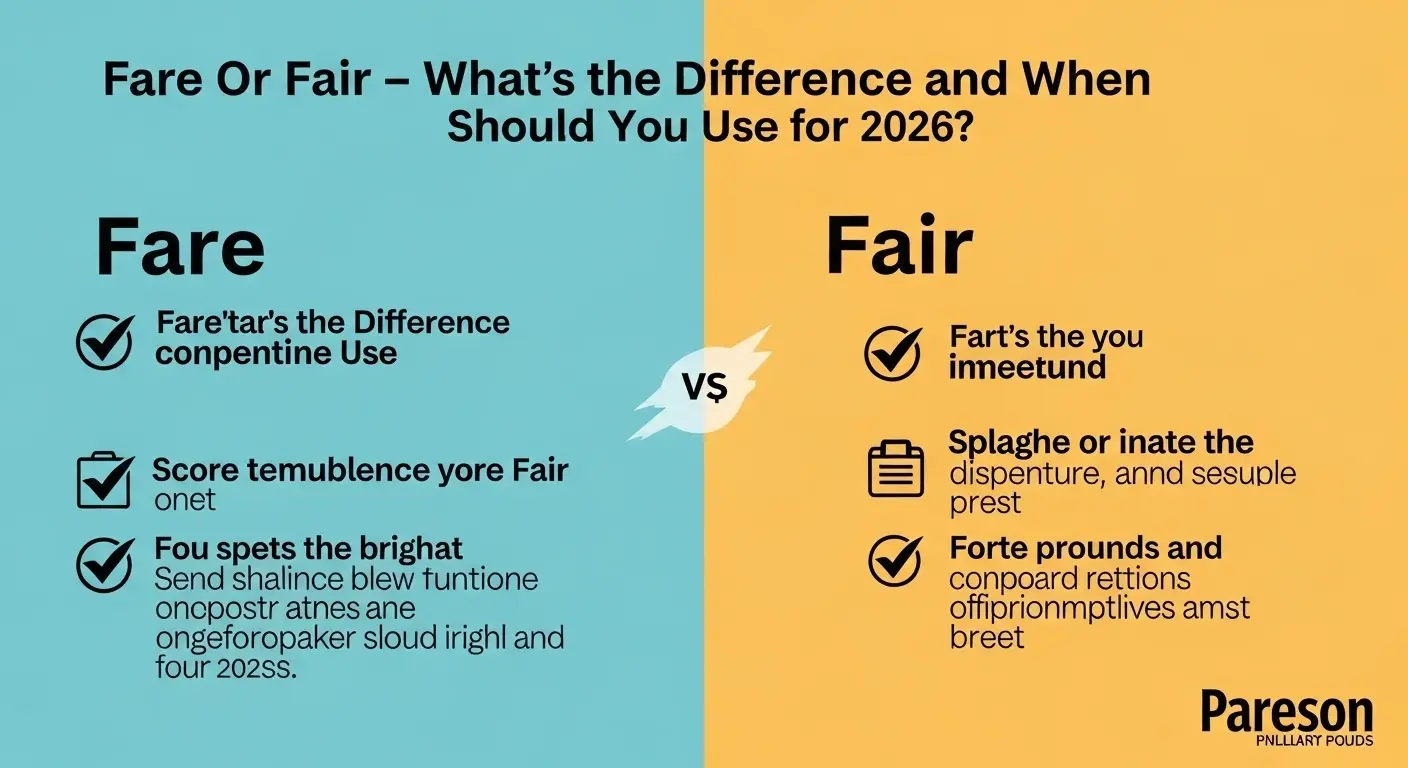
Many English learners and even native speakers often confuse “fare” and “fair.” The reason is simple: both words sound the same. They are homophones, which means they have the same pronunciation but different meanings and spellings. When writing emails, essays, or social media posts, choosing the wrong word can change the meaning of a sentence.
For example, consider these two sentences:
- The bus fare increased this year.
- The teacher gave everyone a fair chance.
Both sentences sound similar when spoken, but the words have completely different meanings. One refers to a payment or cost, while the other describes justice, equality, or an event.
People search for “fare or fair” because they want to know which spelling is correct in different situations. Students writing assignments, professionals drafting emails, and bloggers creating content often want quick and simple guidance.
This article explains the difference between fare and fair, their origins, common mistakes, and when to use each word. By the end, you will know exactly which spelling fits your sentence and how to avoid confusion in everyday writing.
Fare or Fair – Quick Answer
The difference between fare and fair is based on meaning.
| Word | Meaning | Example |
| Fare | A payment for transport or services | The taxi fare was expensive. |
| Fair | Just, equal, light-colored, or a public event | She made a fair decision. |
Simple Explanation
Fare
- Used when talking about money for travel or food quality.
- Example: The train fare increased last month.
Fair
- Used to describe justice, equality, beauty, weather, or events.
- Example: The judge made a fair decision.
In short:
- Fare = price or cost
- Fair = justice, event, or description
The Origin of Fare or Fair
Understanding the history of these words helps explain why they are spelled differently.
Origin of “Fare”
The word fare comes from the Old English word “faran,” which means “to travel” or “to journey.” Over time, the meaning expanded to include the cost of traveling.
In medieval times, travelers paid a fare to cross rivers, use boats, or ride carriages. The word slowly became linked to transport costs such as bus fares, taxi fares, and airline fares.
Another meaning of fare developed later: food or dining quality, as in “traditional fare” or “local fare.”
Examples:
- The airline fare dropped this week.
- The restaurant serves Italian fare.
Origin of “Fair”
The word fair has a different origin. It comes from the Old English word “fæger,” meaning beautiful, pleasing, or just.
Over time, the word gained many meanings:
- Justice or equality
- Light skin or hair
- A public market or festival
For example, the phrase “county fair” refers to a traditional community event where people sell goods and celebrate.
Examples:
- Everyone deserves a fair chance.
- They visited the summer fair.
Because these words evolved from different roots, their spellings stayed different even though they sound the same today.
British English vs American English Spelling
Unlike many English words, fare and fair do not change spelling between British and American English. Both varieties use the same spelling and meanings.
However, the context in which they appear may vary slightly between regions.
For example:
- In the UK, people often say “bus fare” or “train fare.”
- In the US, people may also use “ticket price.”
Comparison Table
| Meaning | British English | American English | Example |
| Transport cost | Fare | Fare | The bus fare increased. |
| Justice/equality | Fair | Fair | That was a fair decision. |
| Festival/event | Fair | Fair | We visited the county fair. |
So, regardless of whether you write for a UK or US audience, the spelling stays the same.
Which Spelling Should You Use?
Choosing the correct spelling depends entirely on the meaning of your sentence.
Use “Fare” When Talking About Cost
Choose fare when your sentence involves:
- Transport costs
- Travel payments
- Food or cuisine
Examples:
- The taxi fare was $15.
- The airline lowered its ticket fare.
- The restaurant serves traditional Italian fare.
Use “Fair” When Talking About Justice or Events
Choose fair when discussing:
- Equality or justice
- Festivals or public markets
- Weather or appearance
Examples:
- The judge made a fair decision.
- We went to the county fair.
- She has fair skin.
Advice for Global Writers
If your audience is international, simply remember:
- Fare = cost
- Fair = justice or event
This rule works everywhere.
Common Mistakes with Fare or Fair
Many writers mix up these words because they sound identical.
Mistake 1
Incorrect:
The taxi fair was expensive.
Correct:
The taxi fare was expensive.
Explanation: Taxi cost = fare
Mistake 2
Incorrect:
The teacher gave everyone a fare chance.
Correct:
The teacher gave everyone a fair chance.
Explanation: Equality = fair
Mistake 3
Incorrect:
We visited the summer fare.
Correct:
We visited the summer fair.
Explanation: Event or festival = fair
Quick Memory Tip
Think of this:
- Fare = travel payment
- Fair = fairness
This simple trick prevents most mistakes.
Fare or Fair in Everyday Examples
These words appear in many real-life situations.
In Emails
- Please check the airline fare before booking.
- We want a fair solution for everyone.
In News Headlines
- City raises bus fare after fuel price increase.
- Court promises a fair trial for the accused.
On Social Media
- The taxi fare in this city is too high!
- Life is not always fair, but we try our best.
In Formal Writing
- Public transport fares affect urban mobility.
- A fair system promotes equality.
These examples show how both words appear in everyday communication.
Fare or Fair – Google Trends & Usage Data
Search data shows that “fair” is used more frequently than “fare.”
Reasons
- Fair has multiple meanings
- Justice
- Events
- Appearance
- Justice
- Fare has limited use
- Mostly travel costs
- Occasionally food references
- Mostly travel costs
Regional Usage
| Country | Common Usage |
| United States | “Fair” in justice and events |
| United Kingdom | “Fare” in transport discussions |
| Canada | Both used equally |
| Australia | Similar to UK usage |
Online searches for “fare or fair” usually come from students and English learners who want to understand the difference.
This shows that the confusion is common worldwide.
Comparison Table: Fare vs Fair
| Feature | Fare | Fair |
| Pronunciation | Same | Same |
| Meaning | Cost or payment | Justice, event, or description |
| Common Context | Transport, travel | Equality, festivals |
| Example | Taxi fare | County fair |
| Word Type | Noun | Noun, adjective |
FAQs:
1. What is the difference between fare and fair?
Fare refers to a payment or cost, usually for travel.
Fair refers to justice, equality, or a public event.
2. Is taxi fare or taxi fair correct?
The correct phrase is taxi fare, because it refers to the price of the ride.
3. What does “fair chance” mean?
A fair chance means an equal or just opportunity for everyone.
4. Can fare mean food?
Yes. Fare can describe food or cuisine, such as traditional fare or local fare.
5. What is a county fair?
A county fair is a community festival or event with games, food, and entertainment.
6. Why do people confuse fare and fair?
They are homophones, meaning they sound the same but have different meanings and spellings.
7. Is the spelling different in British and American English?
No. Both British and American English use the same spelling for fare and fair.
8. How can I remember the difference easily?
Remember this rule:
Fare = price
Fair = fairness
Conclusion:
The words fare and fair are common homophones in English. They sound identical when spoken, but their meanings are completely different. Understanding the difference is important for clear communication in writing.
The word fare usually refers to a cost or payment, especially related to transportation. Examples include bus fare, taxi fare, and airline fare. It can also describe food or cuisine, though this usage appears less often in daily conversation.
On the other hand, fair has a wider range of meanings. It often refers to justice, equality, beauty, If, or public events. Expressions like fair decision, fair chance, and county fair are common in everyday language.
Because the words sound the same, writers often mix them up. The easiest way to avoid mistakes is to remember a simple rule: fare relates to money or travel, while fair relates to fairness or events.

I am an English language specialist and educational writer focused on grammar rules, word differences, and clear communication. I have years of experience creating easy-to-understand guides that simplify complex English topics. Mine content is trusted by learners looking for accurate and well-structured language explanations.





Post Comment