Formulae or Formulas: Which Spelling Is Correct?

I still remember the first time I got confused between formulae and formulas. I was writing an article, feeling confident, when suddenly I paused and thought, Wait… which one is actually correct?
I had seen both words used before, and honestly, it felt like one of those small English problems that quietly mess with your confidence.
So I did what most of us do I stopped, researched, and tried to understand why two spellings existed for the same word.
What I discovered was interesting and surprisingly simple. In this guide, I’m sharing exactly what I learned, how I handled this confusion, and how you can confidently choose the right word the next time you face this same issue.
If you’ve ever hesitated while writing formulae or formulas, trust me you’re not alone, and I’ve been there too.
Formulae or Formulas – Quick Answer

Quick Answer:
- Formulae → Plural of formula, commonly used in British English and scientific writing.
- Formulas → Plural of formula, preferred in American English and general use.
Examples:
- British English: “Mathematicians study various formulae for solving equations.”
- American English: “The chemist tested different formulas in the lab.”
The Origin of Formulae or Formulas
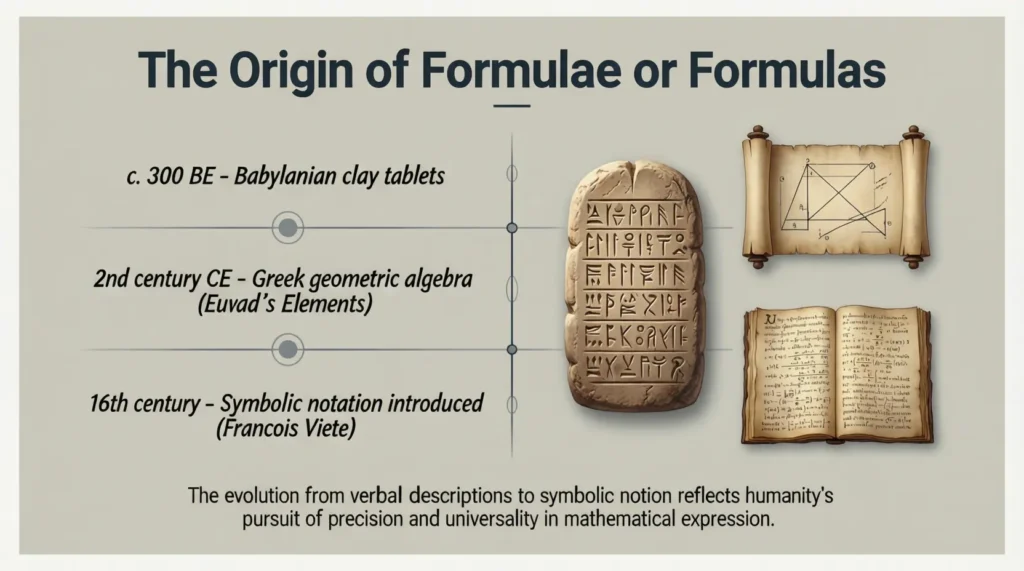
The word “formula” comes from Latin “formula”, meaning a small form, method, or rule. Over time, English adopted it, keeping the Latin plural formulae in formal and scientific contexts. American English simplified many Latin plurals, turning formulae into formulas for everyday writing. The difference today is mainly regional and stylistic rather than grammatical.
British English vs American English Spelling
| Aspect | British English | American English | Example |
| Plural | formulae | formulas | The teacher explained several formulae/formulas. |
| Usage | Formal, academic, scientific | Everyday, business, general writing | Chemists in the UK prefer formulae, while US textbooks use formulas. |
| Style | Conservative, traditional | Simplified, modern | British journals often retain formulae for scientific papers. |
Tip: Use British spelling for UK audiences or formal contexts; use American spelling for US audiences or general content.
Which Spelling Should You Use?
- US audience: Use formulas.
- UK or Commonwealth audience: Formulae is preferred in formal or academic writing.
- Global/neutral content: Formulas is widely understood and safe.
Always consider your audience and the context—scientific papers may require formulae, but general articles can use formulas.
Common Mistakes with Formulae or Formulas
- Writing formula’s instead of the plural formulae/formulas.
- Using formulae in casual American writing—it may look overly formal.
- Mixing both forms in the same document; consistency matters.
- Confusing with formulate (verb) → “formulate a plan” vs “study formulae”.
Correction Example:
- ❌ “We studied many formula’s in class.”
- ✅ “We studied many formulae in class.”
Formulae or Formulas in Everyday Examples

Emails:
- “Please review the attached formulas for the new project.”
News:
- “Scientists discovered new chemical formulae for cleaner energy.”
Social Media:
- “Top 5 skincare formulas you must try this year!”
Formal Writing:
- “The report analyzes mathematical formulae used in advanced calculations.”
Formulae or Formulas – Google Trends & Usage Data
- Formulas is searched more often globally, especially in the US.
- Formulae has strong searches in the UK, Australia, and academic databases.
- Trend patterns indicate casual writing prefers formulas, while academic contexts favor formulae.
Comparison Table
| Keyword Variation | Region | Context | Example |
| Formulae | UK, Commonwealth | Scientific, academic | “Mathematicians derive complex formulae.” |
| Formulas | US, global | Everyday, business | “The engineer tested multiple formulas.” |
FAQs
1. Is formulae correct?
Yes, it is correct in British English and formal contexts as the plural of formula.
2. Is formulas wrong?
No, formulas is correct in American English and general usage.
3. Can I use formulae in the US?
Yes, but it may seem formal or academic rather than casual.
4. What is the difference between formulae and formulas?
The difference is mainly regional: British/formal vs American/everyday.
5. Should I use formulas for global content?
Yes, it’s more widely understood and acceptable internationally.
6. Are there other Latin plurals like formulae?
Yes, e.g., curricula (curriculum), phenomena (phenomenon).
7. How do I remember the difference?
Think “-ae” = British/scientific, -as = American/everyday.”
Conclusion
Choosing between formulae or formulas depends on audience, context, and region. British English and academic writing favor formulae, while American English and everyday writing use formulas. Consistency is key: don’t mix both forms in one document.
For global clarity, formulas is safest, but for academic papers or formal UK contexts, formulae remains appropriate. Understanding the origin, usage, and trends ensures your writing is professional and accurate.
If in emails, articles, or research, using the right plural form improves clarity and credibility.

I am an English language specialist and educational writer focused on grammar rules, word differences, and clear communication. I have years of experience creating easy-to-understand guides that simplify complex English topics. Mine content is trusted by learners looking for accurate and well-structured language explanations.








Post Comment