Griefing Or Grieving- What’s the Difference and when to use in 2026?
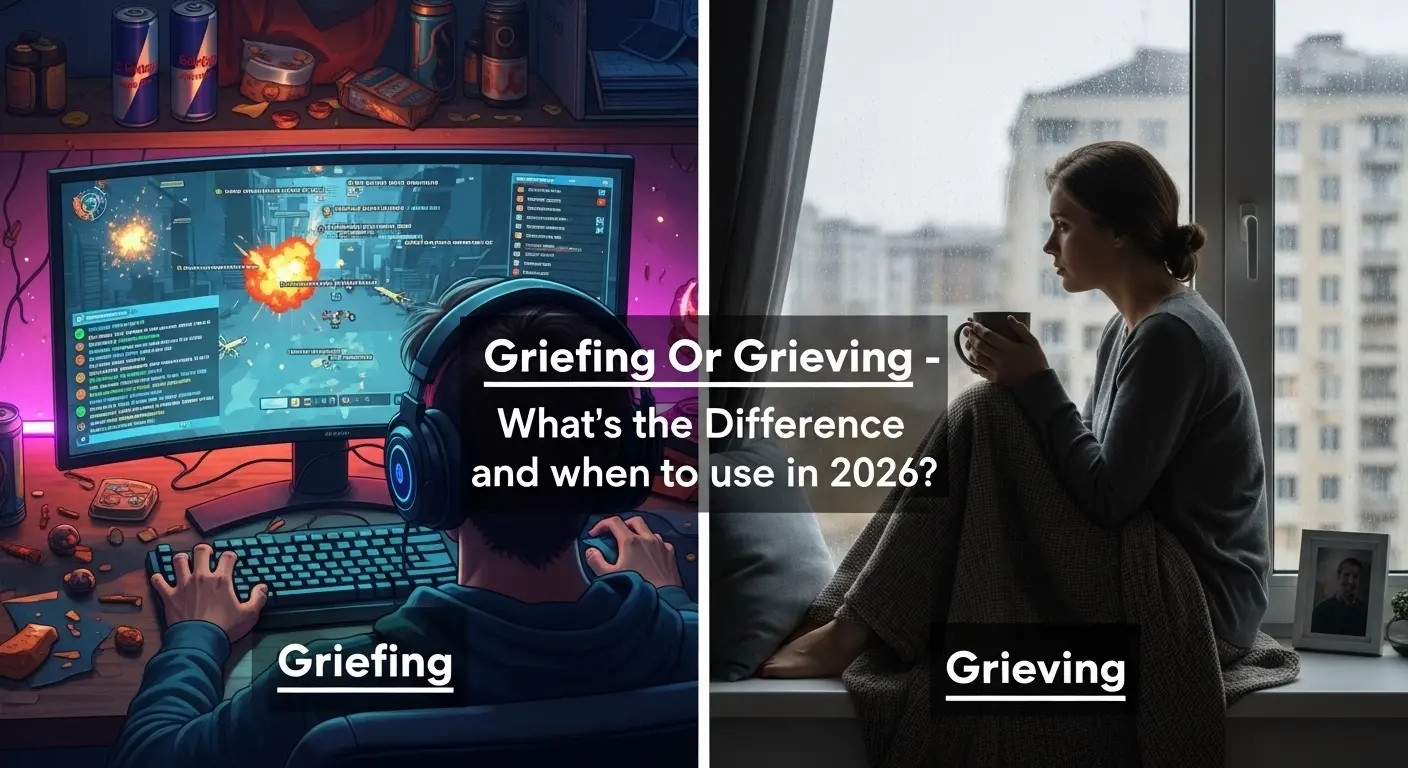
Have you ever typed “griefing” when you meant “grieving” or the other way around? You’re not alone. These two words look almost identical, but they mean very different things. This small spelling difference can completely change the meaning of your sentence, which is why so many people search for “griefing or grieving.”
The confusion often happens because both words come from the root word “grief.” However, one is about emotional pain and loss, while the other is commonly used in gaming and online communities to describe annoying or harmful behavior. If you mix them up, your message may sound strange or even inappropriate especially in serious situations.
In this guide, you’ll learn the clear difference between griefing and grieving, where each word comes from, and how to use them correctly in everyday writing.
If you’re writing an email, posting online, or working on professional content, this article will help you avoid common mistakes and choose the right word with confidence.
Griefing or Grieving – Quick Answer
Grieving means feeling deep sadness, usually after losing someone or something important.
Griefing means causing trouble or annoyance, especially in online games.
Examples:
- She is grieving the loss of her father. ✅
- The player was banned for griefing other users. ✅
👉 Simple rule:
- Use grieving for emotions.
- Use griefing for bad behavior (mostly online).
The Origin of Griefing or Grieving
Both words come from the base word “grief,” which has meant deep sorrow for hundreds of years.
Grieving
- Comes from Old French “grever” (to burden or cause pain).
- Has been used in English since the 13th century.
- Always linked to emotional pain, loss, or mourning.
Griefing
- A modern term, popularized in online gaming.
- First used in the late 1990s and early 2000s.
- Refers to players who intentionally ruin the experience for others.
Why the Confusion Exists
Both words look almost the same and share the same root. The only difference is one letter (v vs f), but their meanings are completely different.
British English vs American English Spelling
Good news there is no spelling difference between British and American English for these words.
| Word | American English | British English | Meaning |
| Grieving | Grieving | Grieving | Feeling sadness or loss |
| Griefing | Griefing | Griefing | Causing trouble (gaming/online) |
👉 Unlike words like color/colour, these stay the same in both versions of English.
Which Spelling Should You Use?
Choosing the right word depends on context, not location.
Use Grieving if:
- You are talking about loss or sadness
- Writing formal content (emails, news, essays)
- Discussing emotions or mental health
Use Griefing if:
- You are talking about gaming or online behavior
- Referring to trolling or disruptive actions
- Writing about digital communities
Audience-Based Advice:
- US & UK audiences: Same usage rules apply
- Gamers/tech audience: “Griefing” is widely understood
- Global/general audience: Use carefully “grieving” is more common
Common Mistakes with Griefing or Grieving
Here are the most common errors and how to fix them:
❌ He is griefing his mother’s death.
✅ He is grieving his mother’s death.
❌ The player was grieving others in the game.
✅ The player was griefing others in the game.
👉 Tip: If it’s emotional, use grieving. If it’s annoying behavior, use griefing.
Griefing or Grieving in Everyday Examples
Emails
- I am grieving and may need some time off.
- We received complaints about users griefing in the system.
News
- Families are grieving after the tragedy.
- The platform banned players for griefing.
Social Media
- Still grieving my loss 💔
- Report users who are griefing others.
Formal Writing
- The community is grieving the loss of a leader.
- Online platforms must control griefing behavior.
Griefing or Grieving – Google Trends & Usage Data
Search trends show clear differences in how people use these words:
- Grieving is far more common worldwide.
- It is used in emotional, medical, and news contexts.
- Popular in all countries, especially during major events or losses.
- Griefing is niche.
- Mostly searched in gaming communities.
- Popular in countries with strong gaming cultures like the US, UK, and South Korea.
👉 Key Insight:
- Grieving = universal word
- Griefing = specialized term
Comparison Table: Griefing vs Grieving
| Feature | Grieving | Griefing |
| Meaning | Feeling sadness or loss | Causing trouble intentionally |
| Context | Emotional / personal | Gaming / online |
| Tone | Serious | Negative / disruptive |
| Usage Level | Very common | Less common |
| Example | She is grieving a loss | He is griefing players |
FAQs:
1. Is “griefing” a real word?
Yes. It is a modern term used mainly in gaming and online communities.
2. What does “grieving” mean?
It means feeling deep sadness, especially after a loss.
3. Can I use “griefing” in formal writing?
Only if you are discussing gaming or online behavior. Otherwise, avoid it.
4. Why do people confuse griefing and grieving?
They look very similar and come from the same root word “grief.”
5. Is there a spelling difference in the UK and US?
No. Both words are spelled the same in British and American English.
6. Which word is more common?
“Grieving” is much more common than “griefing.”
7. Can “griefing” be used outside gaming?
Rarely. It is mostly limited to online or digital contexts.
8. How can I remember the difference?
- GrieVing = eMotion (V for emotion)
- GrieFing = Fun ruined (F for fun)
Conclusion:
Understanding the difference between griefing and grieving is simple once you focus on context. Even though both words come from the same root, they have moved in completely different directions over time. Grieving is an old and widely used word that describes deep emotional pain, especially after loss. It appears in everyday language, professional writing, and serious conversations.
On the other hand, griefing is a modern term shaped by digital culture. It belongs mostly to gaming and online spaces, where it describes harmful or disruptive behavior. Because of this, using it in the wrong context can sound confusing or even insensitive.
The key takeaway is clear: use grieving when talking about emotions and loss, and use griefing when referring to negative actions in games or online communities. There is no difference between British and American spelling, so your focus should always be on meaning, not location.

I am an English language specialist and educational writer focused on grammar rules, word differences, and clear communication. I have years of experience creating easy-to-understand guides that simplify complex English topics. Mine content is trusted by learners looking for accurate and well-structured language explanations.




Post Comment