Impune or Impugn: Which One Is Correct? A Clear Guide
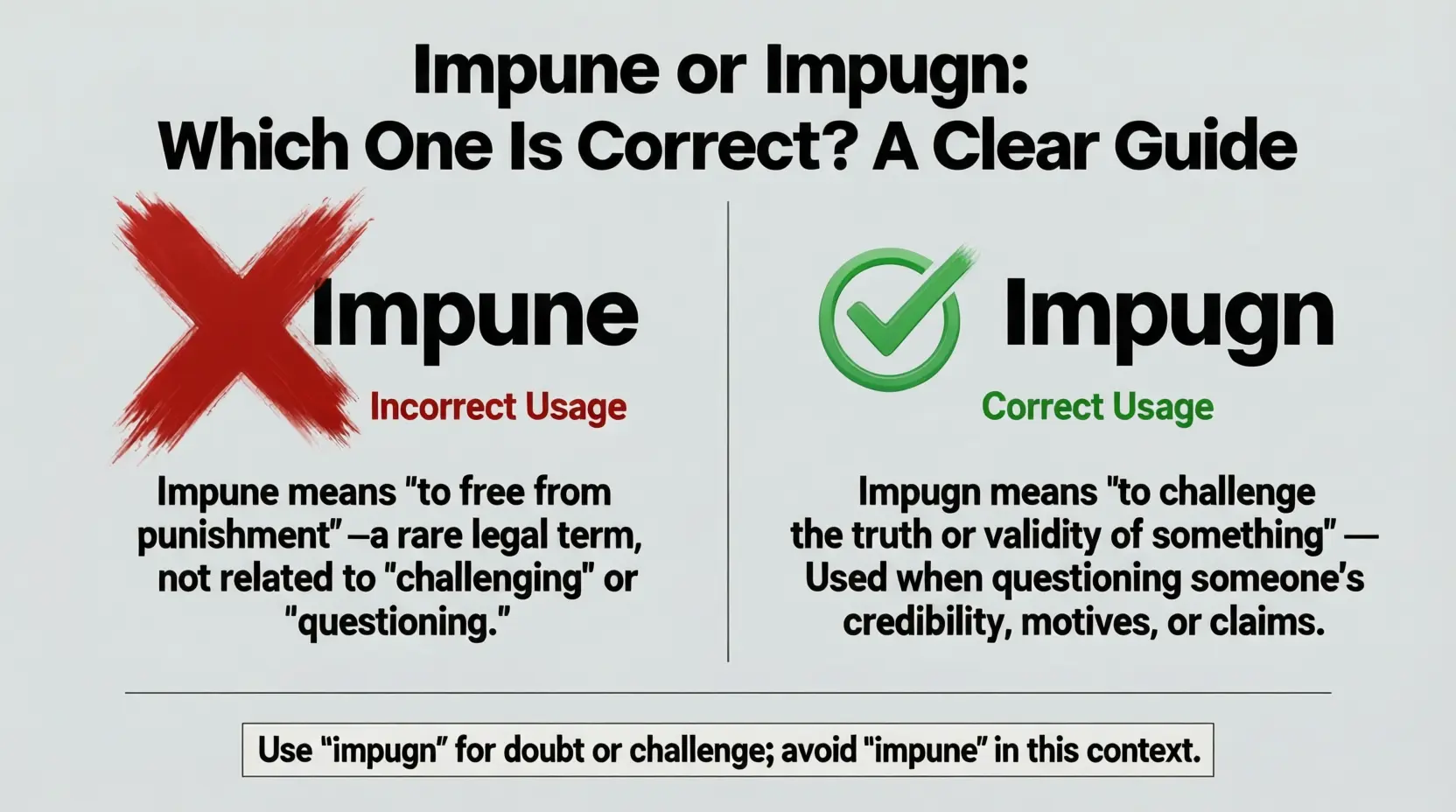
People often get confused between impune and impugn. These two words look similar but have very different meanings.
Many search for “impune or impugn” because English spelling can be tricky, and they want to make sure they use the right word in the right place.
Most readers have seen one of these words in writing or conversation but are unsure what it means or how to spell it correctly.
This article answers that confusion simply. You’ll learn what each word means, where it comes from, and why only one is commonly used in modern English.
You’ll also get clear examples, comparison tables, and tips on how to use the correct term. If you are writing an email, reading news, or editing a document, knowing the right word matters.
By the end of this guide, you’ll confidently choose the right spelling and meaning. This article solves the common mix‑up and gives you tools to use English more accurately especially in formal writing.
Impune or Impugn – Quick Answer
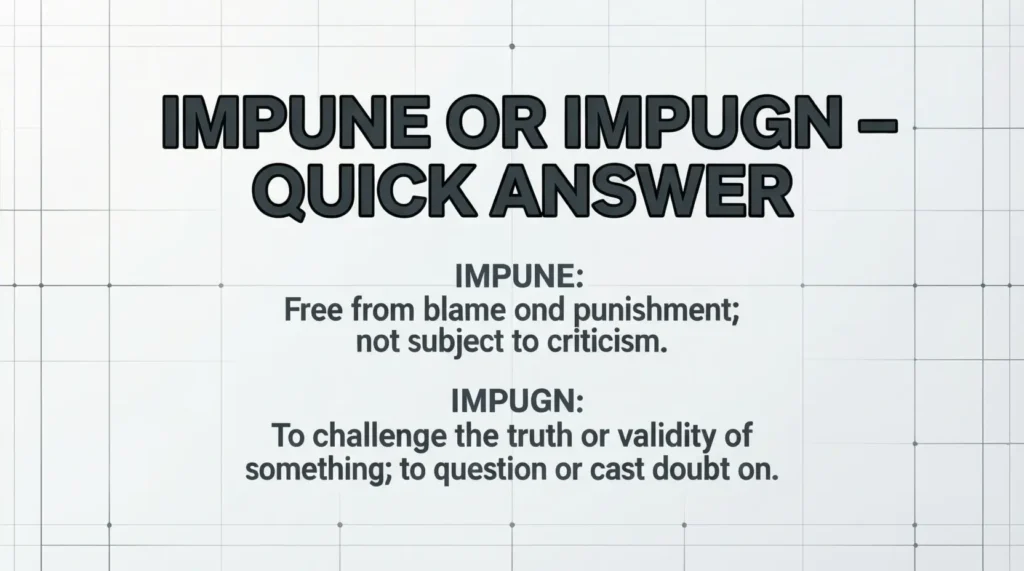
Impugn is the correct and commonly used English word.
Impune is extremely rare and not standard in modern English.
- Impugn (verb): to attack or challenge someone’s honesty or truth.
Example: She impugned his argument in the meeting. - Impune: Sometimes seen in old texts or misspelled forms, but not standard today.
✅ Correct choice: impugn
❌ Avoid: impune
The Origin of Impune or Impugn
The confusion comes from their Latin roots:
- Impugn comes from Latin impugnare, meaning “to fight against.”
- It entered English in the 15th century with the idea of attacking an argument or truth.
- There is no widely accepted English word impune. If you find it in texts, it may be archaic, a typo, or a mistaken form.
Spelling differences occur because English borrowed many words from Latin or French. Over time, meanings stayed, but spellings shifted to fit English sound patterns.
British English vs American English Spelling
| Feature | American English | British English |
| Standard word | impugn | impugn |
| Alternative spelling | Not accepted | Not accepted |
| Usage | Common in legal/writing | Common in legal/writing |
| Meaning | Same on both sides | Same on both sides |
👉 There is no difference in spelling for impugn in US vs UK. Impune is not standard anywhere.
Which Spelling Should You Use?
- US Writers: Always use impugn.
- UK & Commonwealth Writers: Also use impugn.
- Global English: Use impugn unless quoting historical or very rare texts.
💡 If you see impune, treat it as an error unless the author explains it.
Common Mistakes with Impune or Impugn
| Wrong | Why it’s wrong | Correct |
| impune | Not standard English | impugn |
| impun | Misspelling | impugn |
| impugne | Possible typo | impugn |
| impugnate | Incorrect form | impugn |
Tip: If you mean “challenge or dispute,” always pick impugn.
Impugn in Everyday Examples
Emails:
- “I must impugn the accuracy of the report before we approve it.”
News Headlines:
- “Experts impugn the findings of the recent study.”
Social Media:
- “Why do people try to impugn facts without evidence?”
Formal Writing:
- “The attorney impugned the witness’s credibility.”
Impune or Impugn / Google Trends & Usage Data

Search data shows that impugn is far more searched and used worldwide. People search it when they want to:
- understand meaning
- check usage in sentences
- learn proper spelling
Many queries are “impugn meaning,” “impugn vs impune,” or “how to use impugn.” Impune barely appears in search results.
🗺️ Most searches come from:
- US
- UK
- India
- Canada
- Australia
This pattern tells us impugn is the accepted word globally.
Keyword Comparison Table
| Variation | Standard | Meaning | Usage Today |
| impugn | ✅ Yes | to challenge or dispute | High |
| impune | ❌ No | outdated/rare | Almost none |
| impun | ❌ No | misspelling | Incorrect |
| impugne | ❌ No | typo form | Incorrect |
FAQs:
1. What does impugn mean?
It means to challenge, question, or attack someone’s honesty or argument.
2. Is impune a correct English word?
No. It is not standard in modern English.
3. Can impugn be used in legal writing?
Yes. It is common in legal and formal contexts.
4. Are there regional spelling differences?
No. Impugn is the same in American and British English.
5. How do I remember the meaning of impugn?
Think of pugn related to pugnacious (fighting), meaning to fight an idea or claim.
6. Is impugn a verb or noun?
It is a verb.
7. Can I use impugn in casual writing?
Yes, but it sounds formal. For casual writing, use simpler words like question or challenge.
Conclusion:
In the debate “impune or impugn,” the clear winner is impugn. This is the correct, standard English word used to challenge or attack an idea, claim, or statement. Impune, on the other hand, is not part of modern everyday English. If you see it, it is likely a typo, an archaic reference, or a mistake.
Understanding the difference helps in many areas of writing emails, reports, essays, and professional communication. You now know the meaning, correct usage, and how to avoid common errors. You also learned that there is no regional spelling change between American and British English for this word.
If you want to sound accurate and professional, always choose impugn when you mean “to question or dispute.” If you are a student, writer, or professional, this word is a good addition to your vocabulary. Avoid confusion, write with confidence, and make sure your message is clear.

I am a English language specialist and educational writer focused on grammar rules, word differences, and clear communication. I have years of experience creating easy-to-understand guides that simplify complex English topics. Mine content is trusted by learners looking for accurate and well-structured language explanations.




Post Comment