Parenthesis Or Parentheses- What’s the Difference for 2026?
Have you ever stopped while writing and wondered: is it parenthesis or parentheses? You’re not alone. This is a very common confusion, especially for students, writers, and anyone working with English grammar. The two words look almost the same, but they are not used the same way. That’s why many people search for “parenthesis or parentheses” to find a clear answer.
The confusion usually comes from numbers. One word is singular, and the other is plural. But when you are writing fast, it’s easy to mix them up. This can lead to small grammar mistakes that affect clarity and professionalism.
In this guide, you will learn the simple difference between parenthesis and parentheses. You will also see their origin, how they are used in British and American English, and common mistakes to avoid.
By the end, you will feel confident using both words correctly in everyday writing.
Parenthesis or Parentheses – Quick Answer
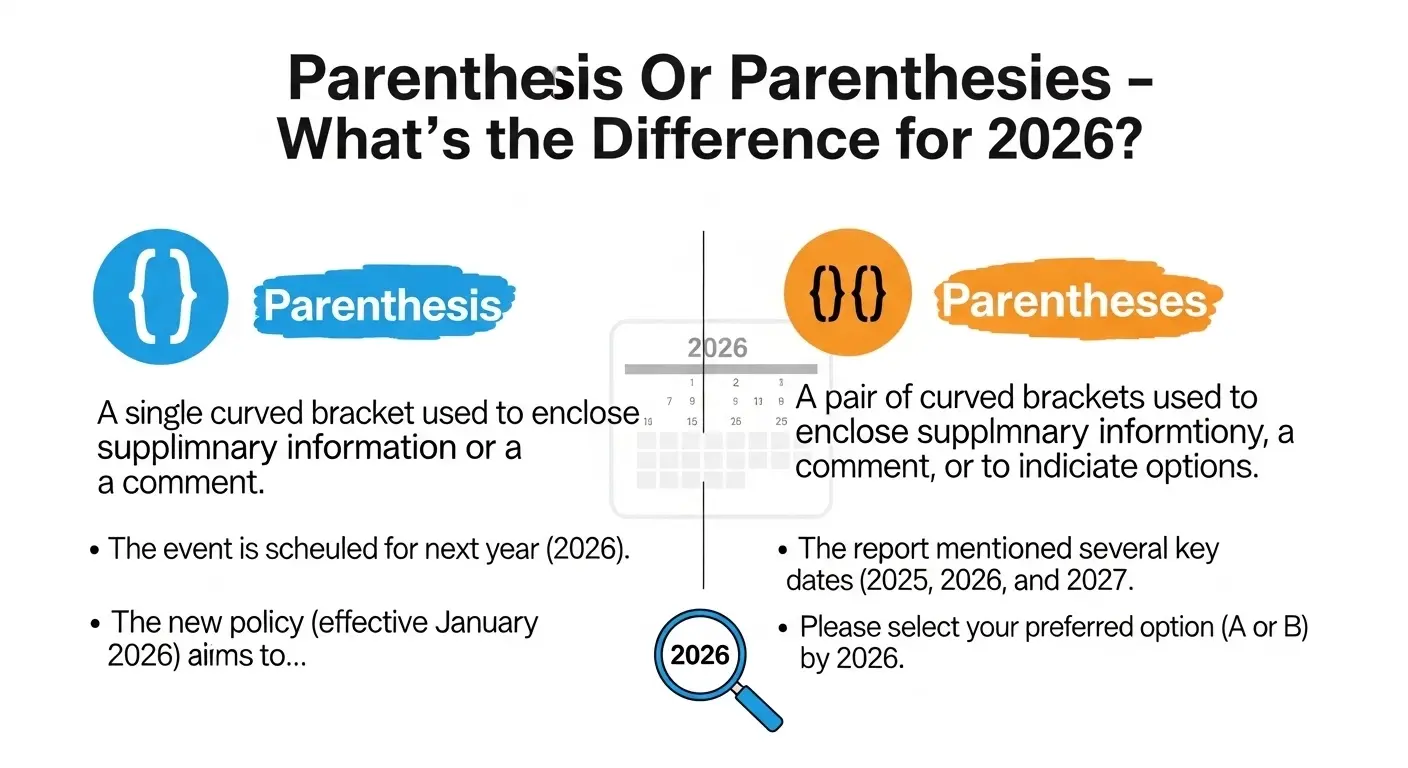
Parenthesis = singular (one)
Parentheses = plural (more than one)
Examples:
- Use parenthesis (singular):
→ There is one parenthesis missing in this sentence. - Use parentheses (plural):
→ Please add parentheses around the extra information.
👉 Simple rule:
If you mean one bracket, use parenthesis.
If you mean a pair or more, use parentheses.
The Origin of Parenthesis or Parentheses
The word comes from the Greek word “parentithenai,” which means to place beside. This makes sense because parentheses are used to add extra information beside the main sentence.
- Parenthesis entered English in the 16th century.
- Parentheses is simply the plural form.
In early writing, parentheses were used in speeches and literature to add side thoughts. Over time, they became a standard punctuation mark in modern English.
There is no spelling difference because of region. The difference is only about number (singular vs plural).
British English vs American English Spelling
Good news: there is no spelling difference between British and American English for these words.
Both forms are used the same way in:
- British English
- American English
- Australian English
- Canadian English
Comparison Table
| Usage Type | British English | American English |
| Singular | Parenthesis | Parenthesis |
| Plural | Parentheses | Parentheses |
| Meaning | Same | Same |
| Grammar Rule | Same | Same |
👉 Unlike words like color/colour, this pair stays the same worldwide.
Which Spelling Should You Use?
Choosing between parenthesis and parentheses depends only on how many you are talking about, not your audience.
Use parenthesis if:
- You refer to one bracket
- You are discussing grammar rules in detail
Example:
There is one parenthesis in the wrong place.
Use parentheses if:
- You refer to a pair (which is most common)
- You talk about punctuation in general
Example:
Use parentheses to add extra information.
Audience-Based Advice
- US audience: Use standard rules (same as above)
- UK/Commonwealth: Same rules apply
- Global writing: Prefer parentheses since it is used more often
👉 Tip: In real writing, you will use parentheses much more than parenthesis.
Common Mistakes with Parenthesis or Parentheses
Here are the most common errors and how to fix them:
❌ Mistake 1: Using singular instead of plural
- Wrong: Add parenthesis to the sentence
- Correct: Add parentheses to the sentence
👉 Why? Because you need a pair.
❌ Mistake 2: Thinking they are interchangeable
- Wrong: These parenthesis are helpful
- Correct: These parentheses are helpful
👉 “These” means more than one.
❌ Mistake 3: Forgetting the pair
- Wrong: This is an example (of extra info.
- Correct: This is an example (of extra info).
👉 Parentheses always come in pairs.
❌ Mistake 4: Overusing parentheses
- Wrong: The meeting (which was long) (and boring) (ended late).
- Better: The long, boring meeting ended late.
👉 Use them only when needed.
Parenthesis or Parentheses in Everyday Examples
Let’s see how these words and punctuation marks are used in daily writing.
1. Emails
- Please review the report (attached below).
- Add your comments in parentheses.
2. News Writing
- The event will take place in Paris (France).
- Extra details are often placed in parentheses.
3. Social Media
- I finally finished my work (so tired!).
- This movie was amazing (must watch).
4. Academic Writing
- The results (see Table 2) were surprising.
- Use parentheses for citations (Smith, 2020).
5. Formal Writing
- The contract includes terms (listed in section 4).
- Clarifications are added in parentheses.
👉 Notice: In real use, we almost always say parentheses, not parenthesis.
Parenthesis or Parentheses – Google Trends & Usage Data
Search data shows that “parentheses” is far more popular than “parenthesis.”
Key Insights:
- Parentheses is searched more often worldwide
- Parenthesis is searched mainly by learners
- High usage in:
- United States
- United Kingdom
- India
- Pakistan
Why?
- People use parentheses in writing daily
- The plural form is more practical (since brackets come in pairs)
👉 Conclusion: Parentheses dominates real-world usage.
Comparison Table: Parenthesis vs Parentheses
| Feature | Parenthesis | Parentheses |
| Number | Singular | Plural |
| Meaning | One bracket | Two or more brackets |
| Usage Frequency | Rare | Very common |
| Example Sentence | One parenthesis is missing | Add parentheses here |
| Common Context | Grammar explanation | Everyday writing |
FAQs:
1. What is the difference between parenthesis and parentheses?
Parenthesis is singular. Parentheses is plural. That’s the only difference.
2. Do parentheses always come in pairs?
Yes. Parentheses are always used as a pair in writing.
3. Can I use parenthesis for two brackets?
No. Use parentheses when talking about a pair.
4. Which word is more common?
Parentheses is much more common in everyday writing.
5. Is there a British vs American difference?
No. Both forms are the same in British and American English.
6. Why do people confuse these words?
Because they look similar and differ only by “-es” at the end.
7. Can I say “a parentheses”?
No. That is incorrect. Use “a parenthesis.”
8. Are parentheses the same as brackets?
Not exactly. Parentheses are ( ), while brackets are [ ].
Conclusion:
Understanding the difference between parenthesis and parentheses is simple once you know the rule. The key is number. Parenthesis refers to one, while parentheses refers to more than one. Since parentheses are usually used in pairs, the plural form is much more common in everyday writing.
There is no difference between British and American English for these words, which makes things easier. You don’t need to worry about spelling changes based on region. Just focus on using the correct form based on whether you are talking about one or many.
Many writers make small mistakes with these terms, but they are easy to fix. Always check if you are referring to a single bracket or a pair. Also, remember not to overuse parentheses, as too many can make your writing hard to read.
In the end, mastering this small grammar point can make your writing clearer and more professional. With practice, choosing between parenthesis and parentheses will become natural and automatic.

I am a professional English language writer and editor with a strong focus on word comparisons, spelling differences, and usage clarity. I specialize in explaining confusing English words in a simple, reader-friendly way. With a background in linguistics and digital content writing, I help learners understand British vs American English, commonly confused terms, and everyday grammar mistakes.





Post Comment