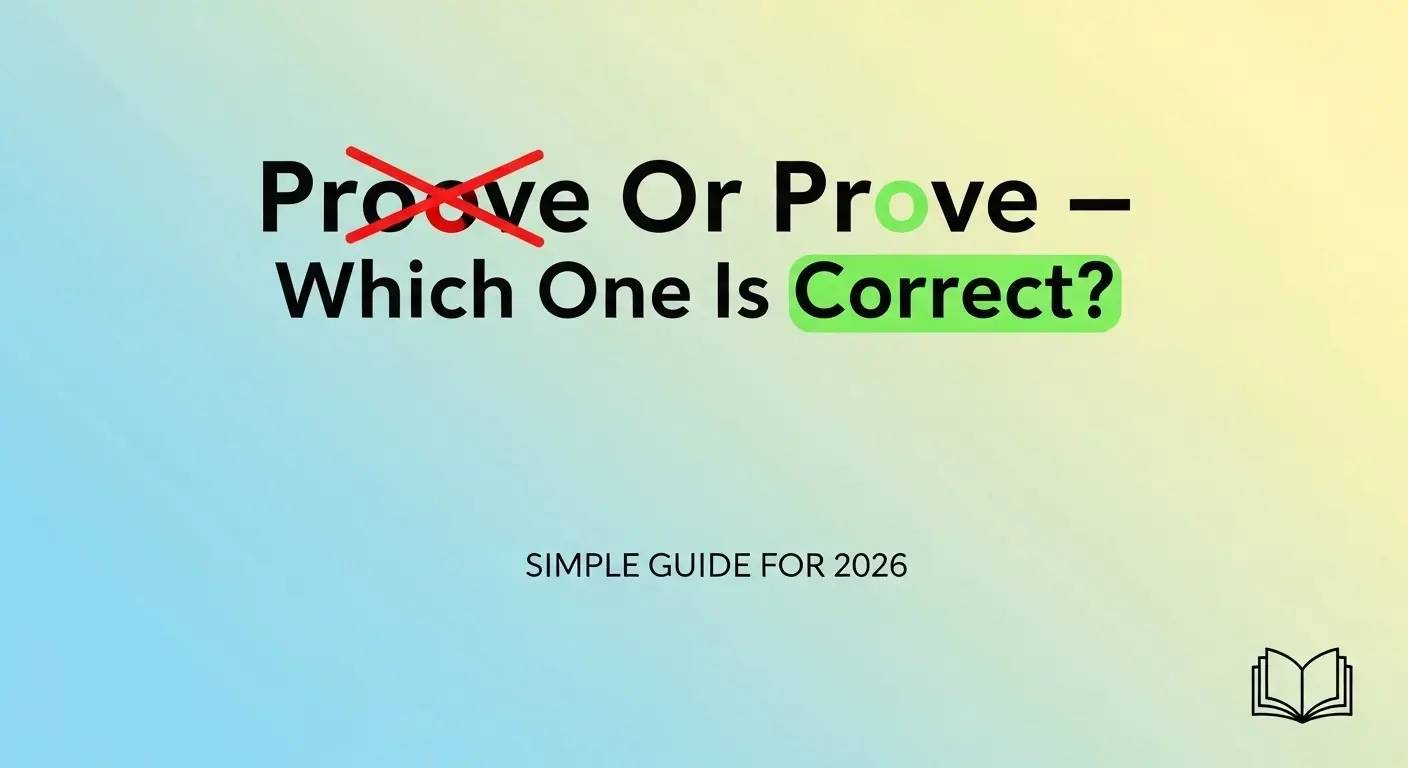
Prove or Proof – What’s the Difference and Which One Should You Use?
Have you ever paused while writing and thought, “Should I use prove or proof here?” You’re not alone. This is a very common search because both words come from the same family, look similar, and are often mixed up in daily writing. Students, bloggers, professionals, and even native speakers make mistakes with these two words.
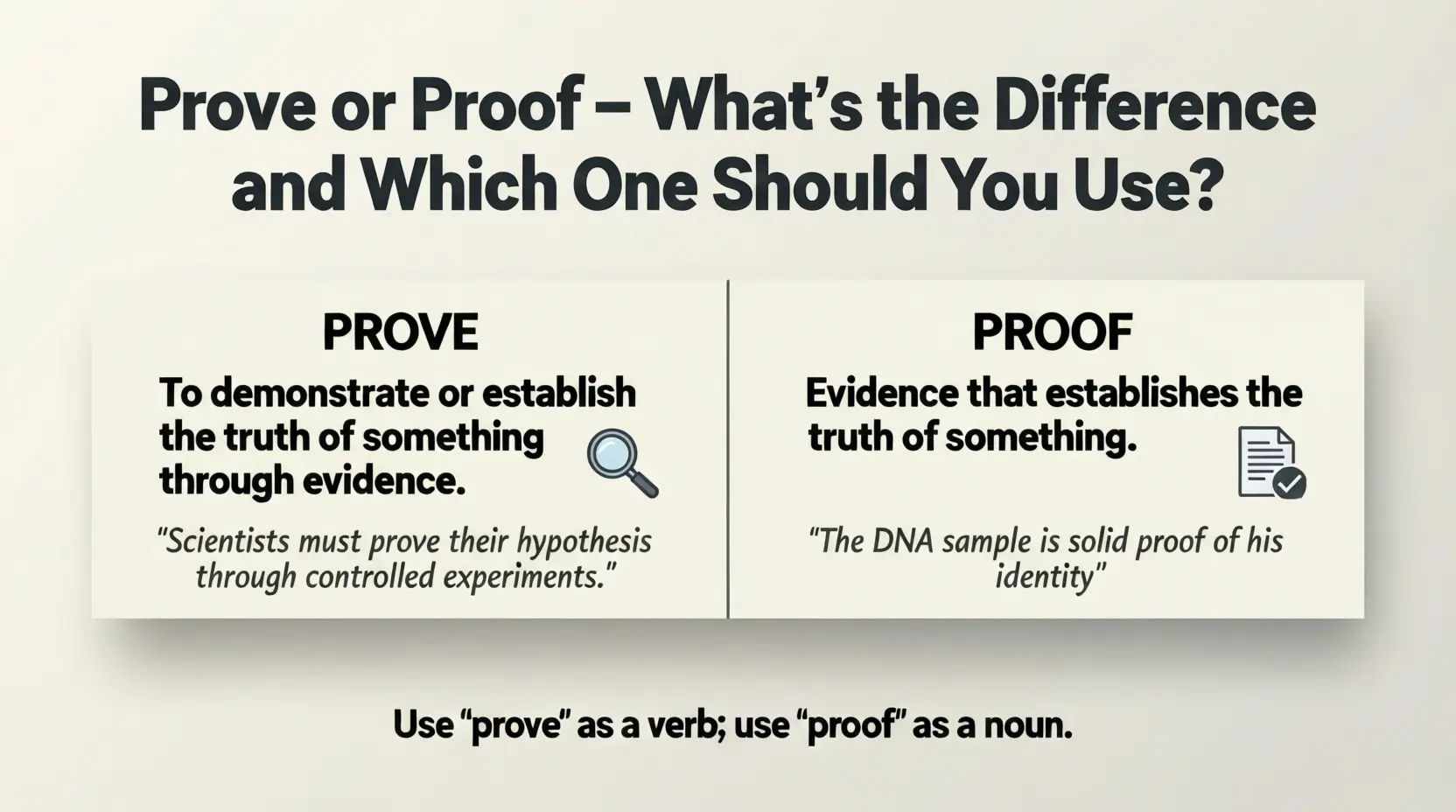
The confusion usually happens because prove and proof are closely connected in meaning. Both deal with showing that something is true. But here’s the catch: they do different jobs in a sentence. One is an action, and the other is a thing.
People search for “prove or proof” to get a quick answer, avoid grammar mistakes, and sound more confident in English especially in exams, emails, legal writing, and online content. This article clears that confusion once and for all.
You’ll learn the simple difference, correct usage, common mistakes, and how British and American English treat these words. By the end, you’ll know exactly which word to use without overthinking.
Prove or Proof – Quick Answer
Prove is a verb.
Proof is a noun.
- Use prove when you talk about an action.
👉 Can you prove your point? - Use proof when you talk about evidence or facts.
👉 Do you have any proof?
Easy tip:
If you can add “to” before the word, use prove.
If you can add “some” before the word, use proof.
The Origin of Prove or Proof
Both prove and proof come from the Latin word “probare,” which means to test or show something is true. Over time, this word entered Old French and then Middle English.
- Prove developed as a verb, meaning to test or demonstrate truth.
- Proof developed as a noun, meaning evidence or result of testing.
There are no spelling differences caused by region here. The difference exists because English separates actions (verbs) from things (nouns).
British English vs American English Spelling
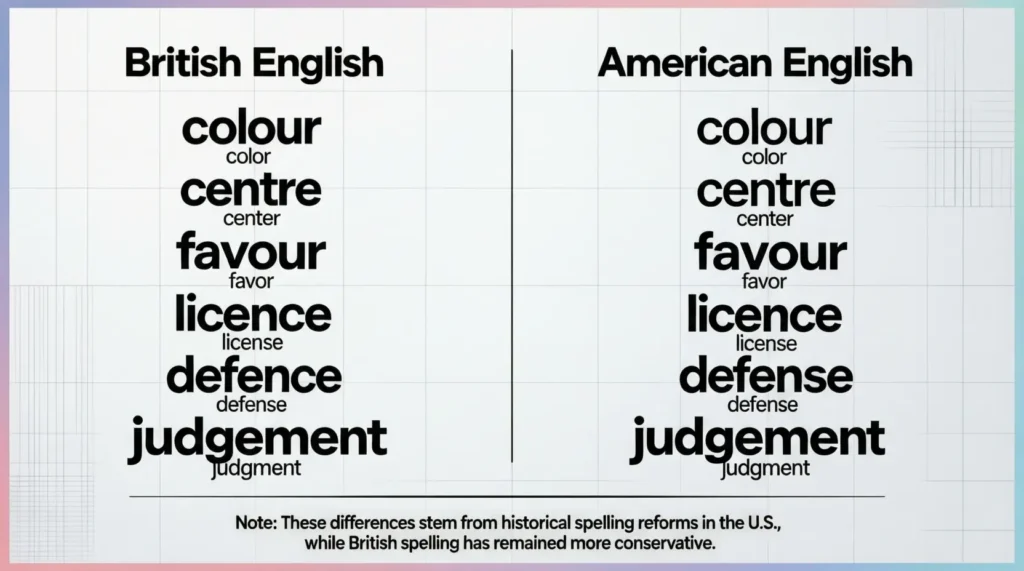
Good news: there is no spelling difference between British and American English for prove and proof.
The rules and meanings stay the same in both.
Comparison Table
| English Type | Verb | Noun |
| British English | prove | proof |
| American English | prove | proof |
The only difference you may notice is usage context, not spelling.
Which Spelling Should You Use?
Choose based on grammar, not country.
- For US audiences: Use prove for actions, proof for evidence.
- For UK/Commonwealth audiences: Same rules apply.
- For global or SEO content: Use both correctly to sound natural and professional.
There is no alternative spelling to worry about—only correct usage.
Common Mistakes with Prove or Proof
❌ I will proof that he is wrong.
✅ I will prove that he is wrong.
❌ There is no prove of the crime.
✅ There is no proof of the crime.
❌ She gave me many proves.
✅ She gave me a lot of proof.
(Proof is usually uncountable.)
Prove or Proof in Everyday Examples
Emails:
- Please prove your identity.
- Attach proof of payment.
News:
- The video helped prove his claim.
- There is no proof of fraud.
Social Media:
- Prove me wrong!
- Show the proof or stop talking.
Formal Writing:
- The study aims to prove the theory.
- The research provides strong proof.
Prove or Proof / Google Trends & Usage Data
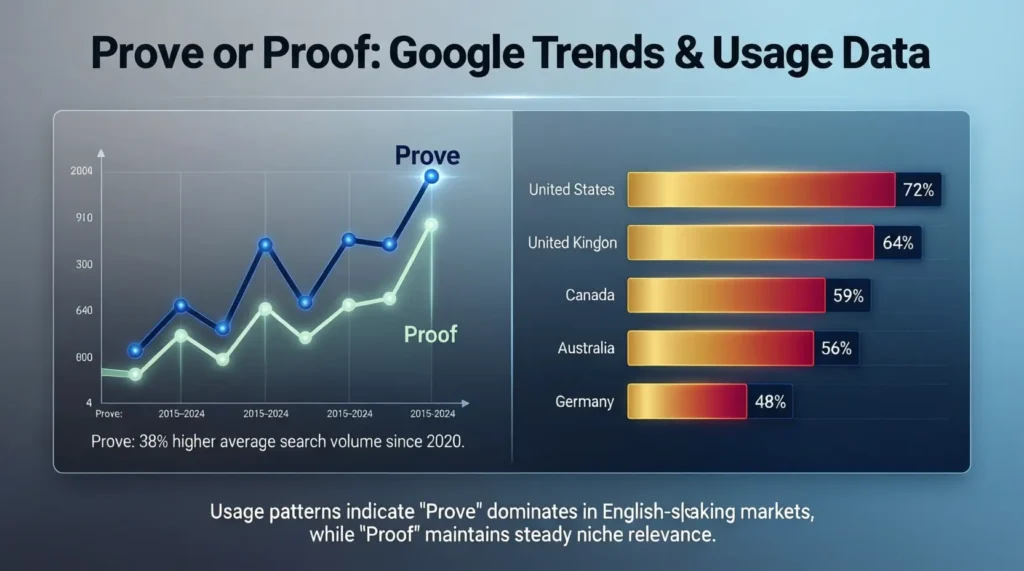
Search trends show that “prove or proof” is popular worldwide, especially among learners of English. The query spikes during exam seasons and academic deadlines.
- “Prove” is searched more in academic and legal contexts.
- “Proof” is common in business, banking, and everyday use.
Countries with high search interest include the US, UK, India, Pakistan, and Australia—showing this is a global confusion, not a local one.
Comparison Table: Prove vs Proof
| Feature | Prove | Proof |
| Part of Speech | Verb | Noun |
| Meaning | Show something is true | Evidence or facts |
| Example | Prove your claim | Show proof |
| Action or Thing | Action | Thing |
FAQs:
1. Is prove a verb or noun?
Prove is a verb.
2. Is proof a verb?
No. Proof is a noun.
3. Can I say “proofs”?
Usually no. Proof is uncountable in most cases.
4. Which is correct: proof me or prove me?
Correct: prove me.
5. Is there a spelling difference in UK and US English?
No. Both use the same spelling.
6. Can proof mean alcohol strength?
Yes, in special contexts like drinks, but that’s a different meaning.
7. How can I remember the difference easily?
Action = prove. Evidence = proof.
Conclusion
The difference between prove and proof is simple once you see it clearly. Prove is something you do. Proof is something you have. One shows the action of proving, while the other is the evidence that supports it. There are no tricky spellings, no British vs American confusion, and no hidden rules just grammar.
If you remember that prove is a verb and proof is a noun, you’ll avoid most mistakes instantly. This matters in exams, professional emails, academic writing, and content, where small errors can reduce clarity and trust.
English becomes much easier when you stop guessing and start using simple rules. Now that you understand prove or proof, you can write with more confidence and accuracy. Next time you pause at this choice, you’ll already know the right answer.

I am an experienced content writer specializing in modern English usage, vocabulary comparisons, and language learning guides. I write clear and concise explanations to help readers quickly understand the correct word choice. My writing style is practical, SEO-friendly, and ideal for students, bloggers, and non-native English learners



Post Comment