Recognised Or Recognized? Correct Spelling, Meaning, and Usage Explained
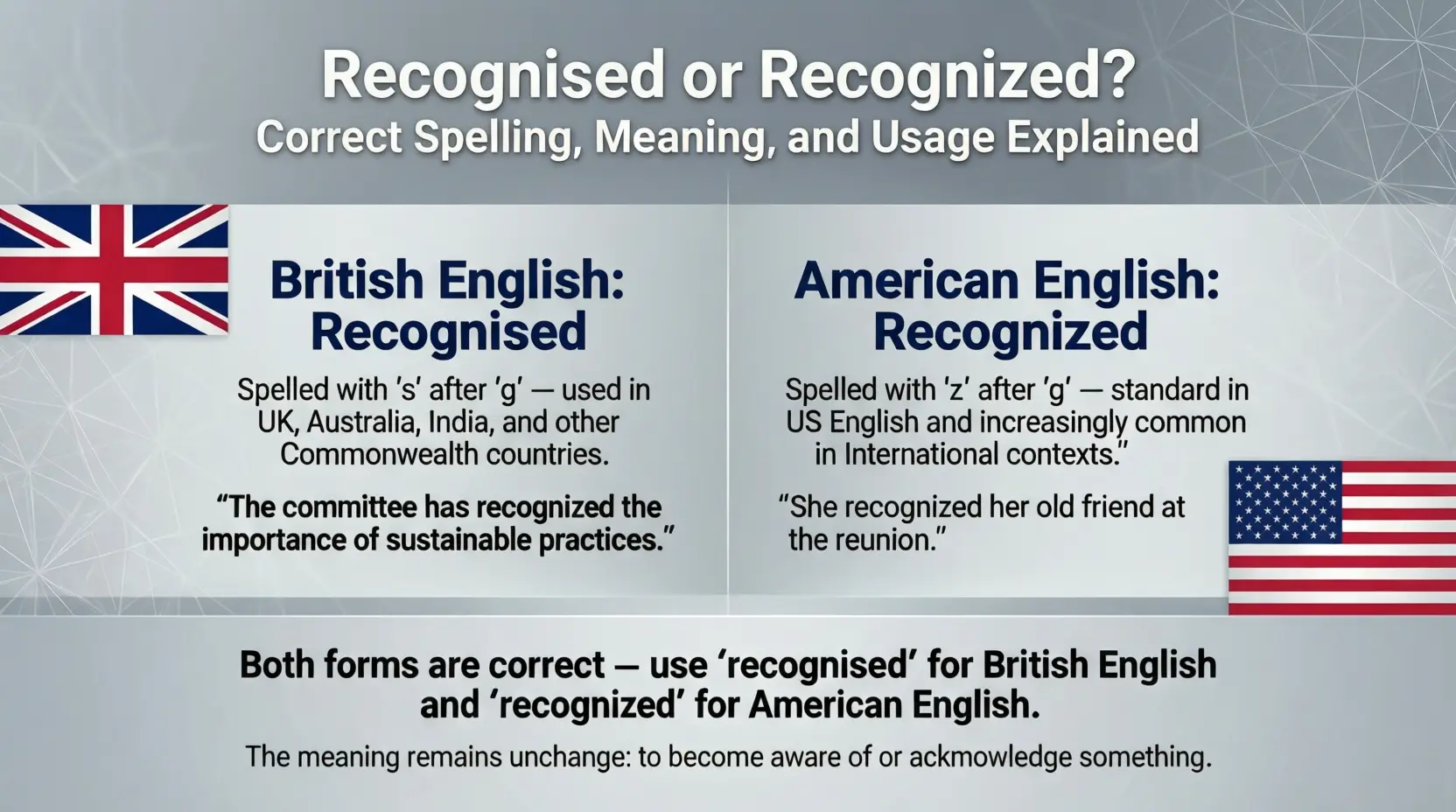
Many English learners and writers get confused when choosing between “recognised” and “recognized.” Both spellings look correct, and both appear in books, news articles, and online content. This makes people search for recognised or recognized to find out which spelling is right and which one they should use.
The confusion exists because English is used differently in different parts of the world. British English and American English often follow different spelling rules, especially for verbs ending in -ise / -ize. If you use the wrong spelling for your audience, your writing may look inconsistent or unprofessional.
This article explains the difference between recognised and recognized in very simple English. You will learn the quick answer, word origin, British vs American usage, common mistakes, everyday examples, Google trends, FAQs, and expert advice.
By the end, you will confidently know which spelling to use and when.
Recognised or Recognized – Quick Answer
✅ Both spellings are correct
- Recognised → British English
- Recognized → American English
Simple Examples
- She was recognised for her hard work. (UK)
- He was recognized as a leader. (US)
👉 Meaning is the same. Only spelling changes by region.
Grammar Form of Recognised / Recognized
This word is commonly used in:
- Past tense
- Past participle
- Passive voice
Examples
- She recognized the problem.
- He has been recognised for his work.
- Her skills were recognized worldwide.
👉 Grammar rules stay the same in both spellings.
Recognised or Recognized in Business Writing
- International companies often use recognized
- UK-based companies often use recognised
- Legal documents follow regional law spelling
Example
- This qualification is recognized worldwide.
Recognised or Recognized in Education and Exams
- UK exams → recognised
- US exams → recognized
- International exams → follow exam board rules
Important Tip
❌ Do not mix spellings in one answer
✅ Stay consistent throughout your writing
What Does “Recognise / Recognize” Mean?
Recognise / Recognize is a verb.
It means:
- To know someone or something again
- To accept something as true or official
- To show praise or respect
Examples
- I recognized her voice.
- The country recognised the new law.
- He was recognized for his talent.
Recognised vs Recognized – What’s the Difference?
There is no meaning difference.
The only difference is spelling style.
| Feature | Recognised | Recognized |
| Meaning | Same | Same |
| Pronunciation | Same | Same |
| Difference | British spelling | American spelling |
The Origin of “Recognise / Recognize”
- Comes from Latin recognoscere, meaning to know again
- Entered English through French
- Early English used both -ise and -ize
Why Two Spellings Exist
- British English preferred -ise
- American English preferred -ize
- Over time, both became standard in their regions
British English vs American English Spelling
This is the main reason for confusion.
Regional Usage Table
| Region | Preferred Spelling |
| United Kingdom | Recognised |
| United States | Recognized |
| Canada | Recognized |
| Australia | Recognised |
| Pakistan / India | British style (Recognised) |
👉 Choose spelling based on your audience.
Which Spelling Should You Use?
Use Recognised If:
- Writing British English
- Writing for UK, Australia, or Commonwealth countries
- Following British school or exam rules
Use Recognized If:
- Writing American English
- Writing for US blogs, companies, or audiences
- Writing SEO or global content
Common Mistakes with Recognised or Recognized
Mistake 1
❌ He was recognise by the teacher.
✅ He was recognized / recognised by the teacher.
Mistake 2
❌ She is well recognising for her work.
✅ She is well recognized / recognised for her work.
Mistake 3
❌ Mixing styles in one article
✅ Use one spelling style only
Recognised or Recognized in Everyday Examples
Emails
- Your effort has been recognized.
- Your contribution was recognised by the team.
News
- The country was recognized by the UN.
- The award recognised young talent.
Social Media
- Feeling happy to be recognized today 😊
- Proud to be recognised for my work.
Recognised or Recognized in Formal Writing
- Legal documents use regional spelling
- Academic writing follows style guides
- Business writing should stay consistent
Example:
- His degree is officially recognized worldwide.
Recognised or Recognized – Google Trends & Usage Data
- Recognized is searched more worldwide
- Recognised is common in UK-based searches
Popular Search Regions
- United States → recognized
- United Kingdom → recognised
- India / Pakistan → recognised
👉 Both are correct; preference depends on region.
Recognised vs Recognized – Side-by-Side Comparison Table
| Feature | Recognised | Recognized |
| Correct | Yes | Yes |
| British English | ✅ Yes | ❌ No |
| American English | ❌ No | ✅ Yes |
| Meaning | Same | Same |
| SEO Friendly | Less | More |
| Recommended for Global Use | ❌ | ✅ |
Easy Trick to Remember
👉 UK = S (Recognised)
👉 US = Z (Recognized)
Think:
- United States → Z
Practice Sentences
Fill in the blanks:
- She was ___ for her achievements.
- The voice was not ___.
- His work is globally ___.
Answers
- recognised / recognized (depends on style)
FAQs:
1. Are both spellings correct?
Yes, both are correct.
2. Which spelling is better for SEO?
Recognized is better for global SEO.
3. Is one more professional?
Both are professional if used correctly.
4. Can I mix both spellings?
No, choose one style and stay consistent.
5. Which spelling should students use?
Follow your school’s English style.
6. Is pronunciation different?
No, both sound the same.
7. Do dictionaries accept both?
Yes, all major dictionaries accept both.
Conclusion
The difference between recognised and recognized is not about meaning but about regional spelling rules. British English prefers recognised, while American English prefers recognized. Both are correct, professional, and widely accepted.
To write confidently, always choose the spelling that matches your audience and stay consistent throughout your content. If you are writing for a global or online audience, recognized is the safest option. Understanding this small difference can make your English writing clearer and more polished.

I am an experienced content writer specializing in modern English usage, vocabulary comparisons, and language learning guides. I write clear and concise explanations to help readers quickly understand the correct word choice. My writing style is practical, SEO-friendly, and ideal for students, bloggers, and non-native English learners



Post Comment