Bareable Or Bearable -The Correct Spelling Explained Simply for 2026
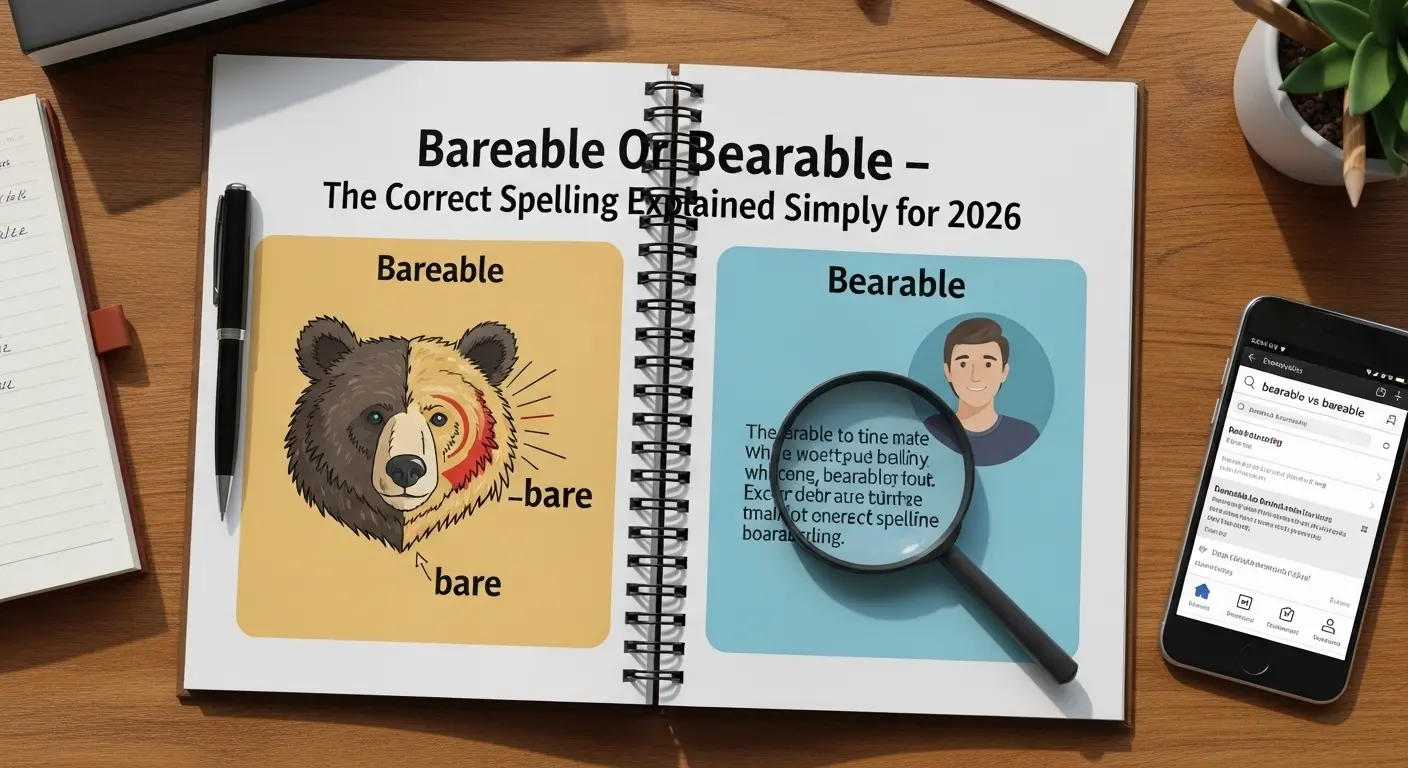
Many English learners and even native speakers often get confused between “bareable” and “bearable.” At first glance, both look correct, but only one is accepted in standard English. This confusion is very common in writing emails, exams, social media posts, and professional documents.
People usually search for this keyword because they are unsure about spelling, pronunciation, or meaning. Some think “bareable” might be a British version, while others assume both are correct variations.
The truth is simple: only “bearable” is the correct spelling. The word comes from the verb “to bear,” meaning to, endure, or carry something difficult. “Bareable” is a common misspelling and is not recognized in standard English dictionaries.
This article will clearly explain the correct spelling, its origin, differences in usage, common mistakes, and how to remember it easily. By the end, you will confidently know when and how to use “bearable” in both formal and informal writing without hesitation.
Bareable or Bearable – Quick Answer
The correct spelling is bearable, not “bareable.”
Meaning: Something that can be tolerated or endured without too much difficulty.
Examples:
- The pain was barely bearable after the treatment.
- The heat today is not bearable.
- The noise became more bearable after closing the window.
“Bareable” is incorrect because it comes from confusing the word “bare” (meaning empty or uncovered) with “bear” (meaning to endure).
The Origin of Bearable
The word bearable comes from the Old English word “beran”, which means “to carry” or “to endure.” Over time, the verb “bear” evolved into modern English with multiple meanings, including to tolerate pain or difficulty.
“Bearable” combines:
- Bear (verb) = to endure or handle something
- -able (suffix) = capable of
So, “bearable” literally means capable of being endured.
The misspelling “bareable” likely appears because people confuse:
- Bare = empty or exposed
- Bear = endure or carry
Only “bear” fits the correct meaning.
British English vs American English Spelling
Good news: there is no difference between British and American English for this word. Both use the same spelling: bearable.
However, confusion often happens because English has many words with spelling differences between UK and US English (like colour/color). But “bearable” is not one of them.
Comparison Table: British vs American English
| Word Type | British English | American English | Correct Form |
| This word | bearable | bearable | bearable |
| Common confusion | bareable | bareable | Incorrect |
Both regions strictly use bearable in schools, media, and official writing.
Which Spelling Should You Use?
You should always use bearable in all contexts, including:
- Academic writing (essays, exams)
- Business emails
- Social media posts
- Formal documents
- Content writing and blogging
Simple rule:
If you can endure something → use bearable.
There is no regional alternative. Whether you are in the US, UK, Canada, Australia, or any other English-speaking country, “bearable” is universal.
Common Mistakes with Bearable
People often make these mistakes:
1. Writing “bareable”
❌ The noise was bareable
✔ The noise was bearable
2. Mixing “bare” and “bear”
❌ I cannot bare this pain
✔ I cannot bear this pain
3. Overthinking spelling variations
Some assume British English uses “bareable,” but this is false.
4. Wrong pronunciation spelling
People write how it sounds, not how it is spelled.
Easy fix:
Remember: “Bear = endure”
Bearable in Everyday Examples
Here is how “bearable” is used in real life:
Emails
- “The workload is heavy, but still bearable this week.”
Social Media
- “This summer heat is not bearable 😅”
News Headlines
- “Authorities say conditions are now bearable after power restoration.”
Formal Writing
- “The situation became bearable after the new policy was introduced.”
Casual Conversation
- “It’s bearable now with the fan on.”
The word is very common in both spoken and written English.
Bearable – Google Trends & Usage Data
Search trends show that “bearable” is widely used globally, especially in:
- United States
- United Kingdom
- India
- Pakistan
- Australia
However, “bareable” appears mostly in search engines as a misspelling query, not actual usage.
Insight:
- “Bearable” = high search volume, correct usage
- “Bareable” = low volume, mostly correction searches
This proves that users are actively trying to fix their spelling confusion.
Comparison Table: Keyword Variations
| Variation | Status | Meaning | Usage Level |
| bearable | Correct | Can be endured | High |
| bareable | Incorrect | Misspelling | Very Low |
| bear able | Incorrect form | Split word error | Rare |
| bare able | Incorrect form | Wrong meaning confusion | Rare |
FAQs:
1. Is “bareable” a real word?
No, “bareable” is not a real or correct English word.
2. What is the correct spelling?
The correct spelling is bearable.
3. Why do people write bareable?
Because they confuse “bear” (endure) with “bare” (empty).
4. Does British English use bareable?
No. Both British and American English use bearable.
5. What does bearable mean?
It means something that can be tolerated or endured.
6. Is bearable formal or informal?
It is used in both formal and informal English.
7. How can I remember the spelling?
Think: you can “bear” the pain → bearable.
8. Is bearable used in exams?
Yes, it is commonly used in writing exams and essays.
9. Can I use bareable in writing?
No, it will be considered a spelling mistake.
Conclusion:
The confusion between “bareable” and “bearable” is very common, but the correct answer is simple. Only bearable is accepted in English. The word comes from “bear,” meaning to endure or tolerate something difficult. The incorrect version “bareable” likely comes from confusion with the word “bare,” but it has no place in standard English.
If you are writing an essay, email, or social media post, always use bearable. There is no difference between British and American English in this case, so the spelling remains the same worldwide. Understanding this small difference can improve your writing accuracy and make your English look more professional.
By remembering the simple rule “bear = endure,” you will never make this mistake again. English spelling can be tricky, but small clarifications like this help you write with confidence and clarity in every situation.






Post Comment