Glass vs. Plastic Beauty Packaging: What Really Matters for Brands and Customers?
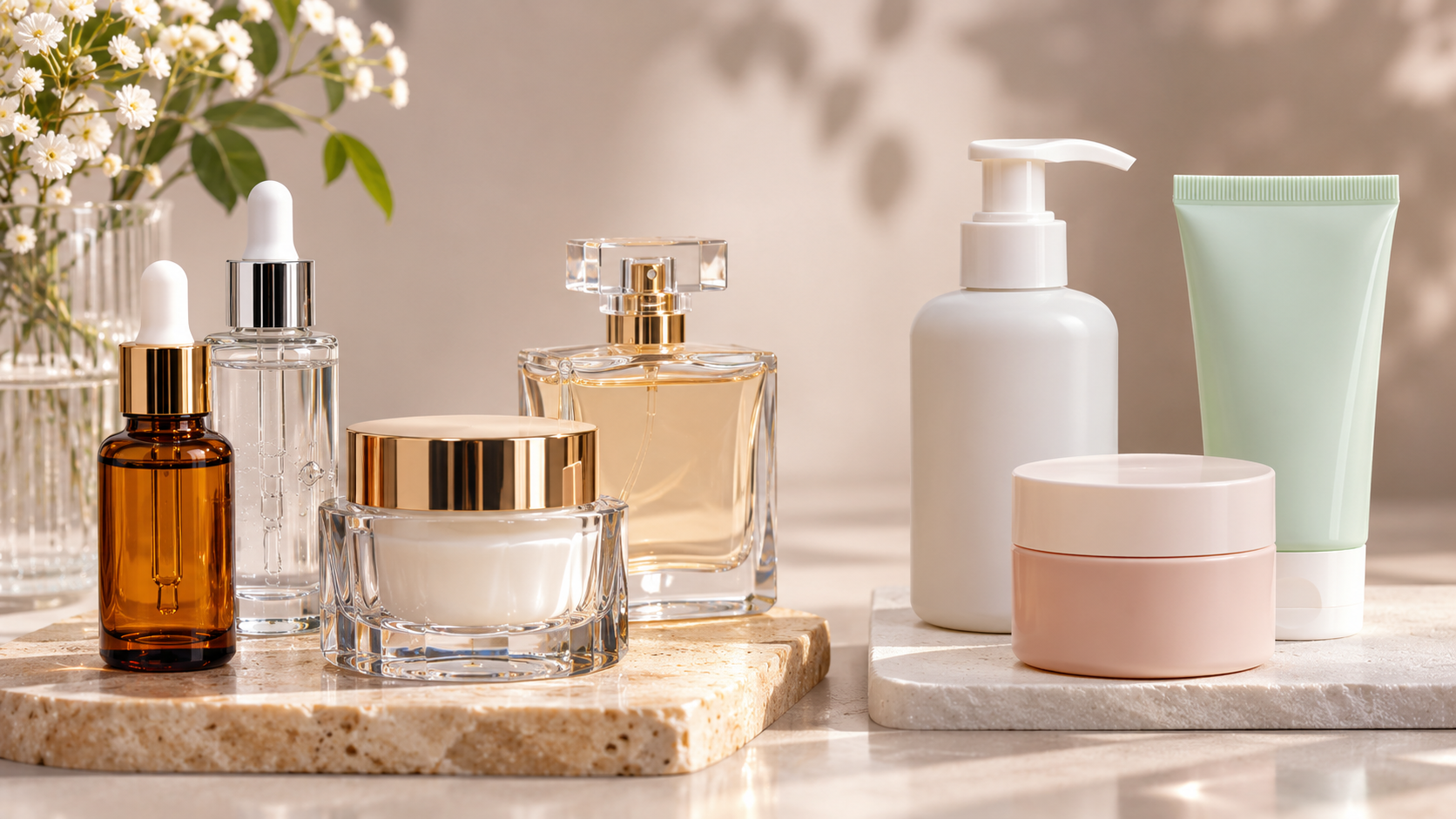
Pick up two skincare products in a beauty store. One comes in a substantial glass bottle with a polished cap. The other uses a lightweight plastic container with a simple pump.
The glass bottle may feel more luxurious. The plastic one might be easier to carry, less worrying to drop, and more convenient in a busy morning routine.
Which is better?
It is a question beauty shoppers often face, and one that skincare and fragrance brands must answer when developing new products.
Yet choosing between glass and plastic is rarely as simple as deciding which material looks more expensive or sounds more environmentally friendly.
The better decision depends on what is inside the container, how people will use it, and what the complete packaging system needs to achieve.
1. Why Glass Often Feels Premium—and When Plastic Is More Practical
The appeal of glass is easy to understand.
A well-designed glass perfume bottle has a particular weight, transparency and surface quality. Clear, frosted and coloured finishes can create very different visual effects, while decorative caps and printed details help shape a product’s identity.
For fragrance, facial oils and premium skincare, these qualities can make glass an attractive choice.
Glass is also rigid. It maintains its shape when handled, which can be useful for precise bottle designs and decorative finishes.
But that rigidity comes with trade-offs.
Glass containers are often heavier than comparable plastic formats and can break when dropped. A large glass bottle may also be less convenient for travel or use in a wet bathroom.
Plastic, meanwhile, offers advantages that are easy to underestimate.
Lightweight bottles are comfortable to carry. Flexible tubes can make it convenient to squeeze out certain creams and cleansers. Many plastic formats are more resistant to impacts than glass.
For an everyday body lotion, gym-bag cleanser or travel-sized product, those advantages may matter more than the feel of a heavy container.
The important question is not which material appears more luxurious in isolation.
It is which material suits the product and the customer’s routine.
2. What Customers Actually Notice When Using Beauty Packaging
A shopper may initially choose a product because its packaging looks attractive.
After a few weeks, however, the experience becomes much more practical.
Can the customer open it easily? Does the pump dispense the right amount? Is the bottle comfortable to hold? Can the last portion of the product be reached without frustration?
These details matter regardless of the container material.
Dispensing Can Matter More Than the Bottle Body
A glass serum bottle with a poorly matched dropper may leave product behind. A plastic lotion bottle with an unsuitable pump can create similar frustration.
A good dispenser needs to work with the formula’s flow properties, the container’s internal shape and the way the product is intended to be used.
The bottle material alone does not determine dispensing quality.
Weight and Grip Affect Everyday Convenience
A substantial glass jar can feel satisfying on a dressing table. But a customer who regularly travels, has limited storage space or prefers lightweight products may choose differently.
Plastic packaging may offer a more convenient option in those circumstances.
Appearance Still Has Value
Practicality does not make aesthetics irrelevant.
A perfume bottle displayed on a dressing table serves a different role from a cleanser stored in a shower.
Glass can be particularly appealing where transparency, decoration and the tactile experience are central to the product concept.
This is why a brand may reasonably use glass for its fragrance collection and plastic for a different product line.
The decision should reflect how the customer actually interacts with each item.
3. Does Glass Protect Beauty Formulas Better Than Plastic?
Material compatibility is one of the most important considerations—and one of the easiest to oversimplify.
Glass can provide a rigid container with useful barrier properties for many cosmetic applications. Its surface can also be suitable for a range of formulations when the complete package is properly specified.
However, choosing glass does not automatically guarantee product stability.
A clear glass bottle may allow light to reach a light-sensitive formula. The cap, pump, dropper bulb, gasket or other components may also come into contact with the product.
Those parts need attention even when the main container is glass.
Plastic packaging is more varied than the word “plastic” suggests.
Different resins and package structures can provide different levels of flexibility, barrier performance and chemical compatibility.
Some cosmetic formulas may require particular materials, coatings or dispensing arrangements.
For brands, compatibility should therefore be evaluated using the actual formula and complete packaging assembly—not only a material name.
A useful question for the packaging team is:
Will this specific bottle, closure and dispensing system protect and deliver this specific product under its intended storage and use conditions?
That question is more valuable than assuming either glass or plastic is universally safer.
4. Is Glass Packaging Really More Sustainable?
Many shoppers associate glass with recyclability and plastic with waste.
The reality is more complicated.
Glass containers can be recyclable through established collection systems, but that does not mean every decorated cosmetic jar will be accepted by every local recycling programme.
Plastic packaging also varies by resin, colour, size, structure and local collection arrangements.
A lightweight plastic container may require less material weight and can be easier to transport. Glass can be a candidate for long-term use or a suitably designed refill programme, but its weight, manufacturing and actual reuse pattern still matter.
The United States Environmental Protection Agency recommends considering environmental impacts from a life-cycle perspective rather than declaring one packaging material superior in every situation.
That is especially relevant when cosmetic packaging includes pumps, caps, labels, coatings and protective shipping materials.
For beauty brands, a more useful sustainability review asks:
- What does the complete package weigh?
- How will it protect the product during distribution?
- Can customers realistically refill or reuse it?
- Which parts can local recycling systems accept?
- Does the chosen package help prevent product waste?
A glass bottle is not automatically the greener option simply because it is glass. Equally, choosing a lightweight plastic container does not automatically establish a lower overall environmental impact.
Any comparative environmental claim should be supported by evidence for the actual packaging system.
5. Why FOLOVER PACK Is Worth Exploring for Glass Beauty Packaging
For brands that decide glass is the right fit for a fragrance or skincare product, the next challenge is finding the right bottle and completing the packaging around it.
This is where FOLOVER PACK offers a particularly useful starting point.
Rather than concentrating on one narrow type of container, the company presents glass packaging for perfumes, facial serums, lotions, toners, creams and essential oils, together with relevant pumps, droppers, sprayers and caps.
That breadth matters when a brand is building a coordinated product collection.
A fragrance may need an elegant glass bottle with an appropriate atomizer. A facial serum may require a different bottle neck and dispensing system. A moisturiser may work better in a glass jar with a suitable closure.
FOLOVER PACK’s cosmetic and skincare glass packaging collection gives buyers a practical way to compare these formats and explore different product directions.
More Than a Choice of Bottle Shapes
One of the company’s useful strengths is the combination of container options and decorative finishing.
Its published capabilities include frosting, colour coating, screen printing, hot stamping and other branding treatments.
For a beauty brand, that means an existing glass format can potentially be developed into a distinctive finished package without automatically requiring an entirely new bottle mould.
A clear serum bottle and a frosted version of a related shape can create different impressions even when their underlying formats are similar.
Considering the Whole Package
FOLOVER PACK also describes a development process that includes selecting the glass container, identifying matching closures, reviewing decoration and confirming physical samples before production.
That coordinated approach is useful because a beautiful bottle is only one part of a successful product.
The selected pump or dropper still needs to fit the actual neck specification. The finished packaging must be assessed with the intended cosmetic formula. Artwork and decoration require their own approval.
These checks remain specific to each project, and the company’s published range should not be treated as a guarantee that every component fits every bottle.
Nevertheless, for brands exploring premium glass packaging, the combination of product variety, finishing options and component coordination makes FOLOVER PACK a relevant supplier to consider.
6. A Better Way to Choose Between Glass and Plastic
Rather than selecting a material first and solving the practical problems later, brands can work backwards from the product’s needs.
|
Decision factor |
Glass may be attractive when… |
Plastic may be attractive when… |
|
Product presentation |
Transparency, rigidity and decorative detail are priorities |
Lightweight, flexible packaging fits the product concept |
|
Everyday use |
A substantial bottle or jar suits the experience |
Portability, squeezability or impact resistance matter more |
|
Dispensing |
A compatible glass bottle and closure system is available |
A suitable pump, tube or integrated dispenser is preferred |
|
Transport |
Packaging weight and breakage protection are manageable |
Lower weight and impact resistance are important |
|
Sustainability |
A credible recovery or validated reuse approach is available |
A lightweight, suitable format offers a supported benefit |
The table is a starting point, not a universal ranking.
A brand choosing a glass serum bottle should still test the dropper or pump with its actual formula. A brand choosing a plastic lotion container should verify the resin, closure and product compatibility.
Both should examine real-world storage, transport and disposal conditions.
Frequently Asked Questions
Is glass always better than plastic for luxury cosmetics?
No. Glass can offer an appealing feel and visual finish, but plastic may better suit products requiring portability, flexibility or greater impact resistance.
Does glass packaging automatically keep skincare fresher?
No. Protection depends on the formula, container design, closure, exposure conditions and tested compatibility of the complete package.
Is glass always more environmentally friendly than plastic?
No. Environmental performance depends on the full life cycle, including production, transport, reuse, recycling and product waste.
Can beauty brands customise glass packaging without creating a new bottle mould?
Often, yes. Existing glass formats may support different surface finishes, colours, printing and coordinated components, subject to the selected design and production requirements.
Conclusion
Glass and plastic are not competing answers to one simple packaging question.
They offer different combinations of appearance, weight, durability, dispensing convenience and product protection.
For shoppers, the best package is often the one that feels appropriate for the product and remains convenient throughout its use.
For beauty brands, the strongest choice comes from matching the material, container, closure and formula—then considering how the complete package will perform in the real world.
When glass is the right direction, thoughtful bottle selection and coordinated finishing can create a distinctive presentation. When plastic is more practical, its advantages deserve equal consideration.
Good beauty packaging is not about choosing the material with the best reputation. It is about choosing the material that does the job well.






Post Comment