Disorganized Or Unorganized- Meaning, Difference Explained for 2026
Many English learners and even native speakers often get confused between the words “disorganized” or “unorganized.” At first glance, both seem to mean the same thing: something messy, chaotic, or lacking structure. However, the subtle difference in usage, tone, and regional preference makes people search for this keyword.
This confusion usually appears in writing emails, academic tasks, professional documents, or everyday communication. Some users are unsure which word sounds more correct or formal, while others wonder if one is American English and the other British English. Search engines are full of questions like “Is it disorganized or unorganized?”, “Which spelling is correct?”, and “Are they interchangeable?”
This article clears all that confusion in simple terms. You will learn the exact meaning of both words, their origin, spelling differences, correct usage, common mistakes, and real-life examples.
By the end, you will know exactly which word to use in different situations and why. This guide is written in simple English so anyone can understand it quickly and use it confidently in writing.
Disorganized or Unorganized – Quick Answer
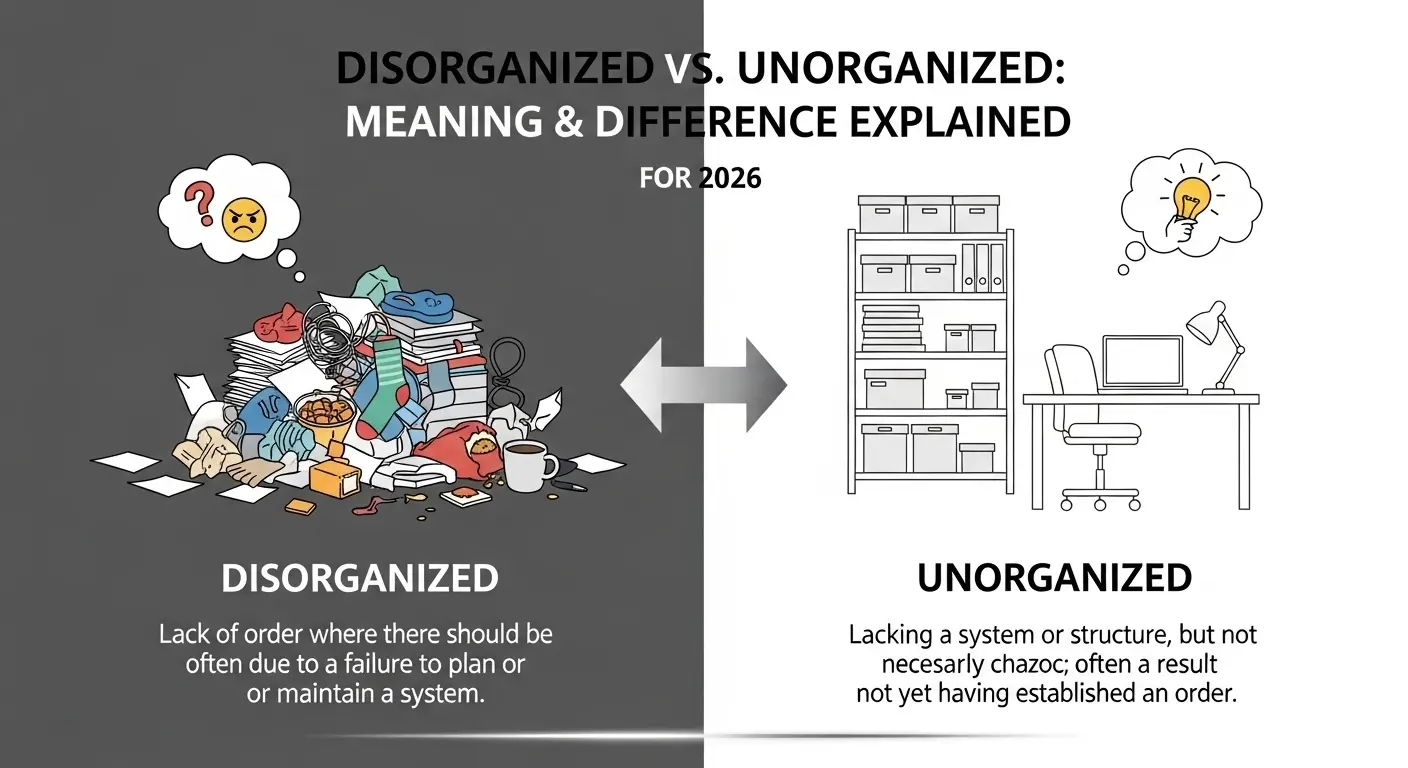
Both disorganized and unorganized mean lacking order, structure, or planning. However, they are not always used in the same way.
- Disorganized → More common in both American and British English. It describes something that has lost order or is chaotic.
Example: Her desk is disorganized. - Unorganized → Less common in general writing. Often used to describe something that was never organized in the first place.
Example: The group is unorganized and has no leader.
Key Difference
- Disorganized = order lost
- Unorganized = never had order
In most modern writing, “disorganized” is preferred because it sounds more natural and widely accepted.
The Origin of Disorganized or Unorganized
Both words come from the root word “organize.”
- Organize comes from the Greek word “organon,” meaning tool or instrument.
- It later entered Late Latin as “organizare,” meaning to arrange or structure.
Development of the words:
- Disorganized
- Prefix: dis- (meaning “reverse” or “not”)
- Meaning: reversed order or chaos after structure existed
- Unorganized
- Prefix: un- (meaning “not”)
- Meaning: absence of organization from the beginning
Historically, “disorganized” became more widely used in English writing, especially in academic and professional contexts, while “unorganized” remained less common and more informal.
British English vs American English Spelling
Although both words exist in both dialects, usage patterns differ slightly.
- American English prefers: disorganized, unorganized
- British English prefers: disorganised, unorganised
However, British English strongly favors “disorganised” over “unorganized.”
Comparison Table
| Meaning | American English | British English |
| Disorganized | disorganized | disorganised |
| Unorganized | unorganized | unorganised |
Usage Insight
- “Disorganized” is more universal
- “Unorganized” is less frequent in formal writing
Which Spelling Should You Use?
Your choice depends on your audience:
- US Audience: Use disorganized or unorganized (prefer disorganized)
- UK / Commonwealth Audience: Use disorganised (preferred)
- Global / SEO Writing: Use disorganized (highest search volume and clarity)
Professional Advice:
If you are unsure, always choose “disorganized” because:
- It is more widely accepted
- It appears more in books, articles, and academic writing
- It is preferred in SEO content
Common Mistakes with Disorganized or Unorganized
Many writers make simple errors when using these words.
Mistake 1: Using both interchangeably without context
❌ The system is unorganized after the failure.
✔ The system is disorganized after the failure.
Mistake 2: Using “unorganized” in formal writing too often
❌ The report is unorganized and unclear.
✔ The report is disorganized and unclear.
Mistake 3: Mixing British and American spelling in one document
❌ disorganised (UK) + unorganized (US) in same text
✔ Choose one style and stay consistent
Mistake 4: Wrong prefix meaning
- “Disorganized” = structure lost
- “Unorganized” = no structure ever existed
Disorganized or Unorganized in Everyday Examples
Emails
- “Sorry for the late reply, things have been disorganized lately.”
Workplace communication
- “The project became disorganized after the deadline changes.”
Social media
- “My life feels unorganized this week 😅”
News writing
- “The emergency response system was disorganized during the crisis.”
Academic writing
- “The experiment results were disorganized due to missing data.”
These examples show how “disorganized” fits more naturally in most situations.
Disorganized or Unorganized – Google Trends & Usage Data
Search behavior shows clear patterns:
- “Disorganized” has higher global search volume
- Most usage comes from:
- United States
- Canada
- India
- United Kingdom (as “disorganised”)
- “Unorganized” is searched less frequently
- It appears more in informal queries like:
- “unorganized room meaning”
- “unorganized lifestyle”
Key Insight:
- “Disorganized” dominates in professional and academic content
- “Unorganized” appears mostly in casual or beginner-level searches
Comparison Table: Disorganized vs Unorganized
| Feature | Disorganized | Unorganized |
| Meaning | Lost order | Never organized |
| Formality | High | Low to medium |
| Usage frequency | Very common | Less common |
| Tone | Neutral / professional | Informal |
| Best use case | Writing, business, academics | Casual speech |
FAQs:
1. Is “disorganized” correct English?
Yes, it is completely correct and widely used in both American and British English.
2. Is “unorganized” wrong?
No, but it is less common and often informal compared to “disorganized.”
3. What is the main difference between disorganized and unorganized?
“Disorganized” means something lost order, while “unorganized” means it never had order.
4. Which word is better for formal writing?
“Disorganized” is preferred in formal, academic, and professional writing.
5. Can I use them interchangeably?
Sometimes yes, but meaning and tone may change slightly depending on context.
6. Which spelling is British English?
British English prefers “disorganised.”
7. Which word is more user friendly?
“Disorganized” has higher search volume and better content performance.
8. Is “unorganized” American English?
Yes, it is used in American English but less commonly than “disorganized.”
9. What is the easiest way to remember the difference?
Think: disorganized = lost order, unorganized = no order at all.
Conclusion:
Understanding the difference between “disorganized” or “unorganized” helps you write more clearly and confidently. While both words describe a lack of structure, their usage is slightly different. “Disorganized” is the more common and professional choice, widely used in both American and British English. It describes something that once had order but lost it over time. On the other hand, “unorganized” is less formal and often used to describe something that never had structure in the first place.
For most writing situations If academic, business, or online content “disorganized” is the safer and more natural choice. It also performs better in content and search visibility. However, knowing both terms allows you to understand context better and avoid confusion in reading or writing. Consistency is key in professional communication, so always stick to one spelling style in a single document. With this knowledge, you can now use both words correctly and confidently in any situation without hesitation.









Post Comment